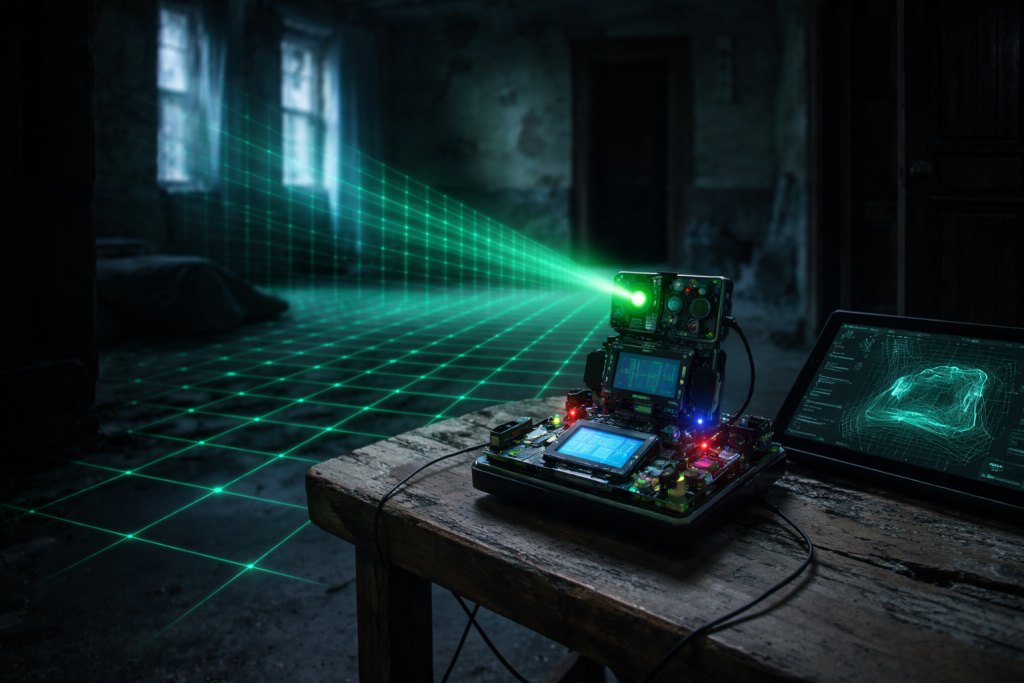
ESP32 Paranormal & Anomaly Detection
I recently came across a DIY $30 ESP32 room mapper project that uses an ESP32 microcontroller paired with a Time-of-Flight (ToF) distance sensor and an inertial measurement unit (IMU) to scan and map the geometry of a room in real time. The entire setup is compact, inexpensive, and open-source, making it something almost anyone can build at home with basic electronics skills.
What immediately stood out to me is how easily this same technology could be adapted for paranormal research.
Instead of simply mapping walls and furniture, an ESP32-based system could be configured to monitor changes within a space over time. By logging movement patterns, distance changes, or environmental shifts, investigators could establish a baseline reading for a room and then watch for deviations. Because the ESP32 includes built-in Wi-Fi and Bluetooth, data can be streamed live to a laptop or mobile device, or stored locally for later analysis during overnight investigations.
The real power of the ESP32 platform is its flexibility. It supports a wide range of sensors, allowing you to build a multi-sensor monitoring station tailored specifically for research environments.
Some sensor ideas that would integrate well include:
- mmWave radar or microwave motion sensors for detecting subtle movement, even through light obstructions.
- Ultrasonic distance sensors to create wider scanning coverage or 360-degree sweeps.
- Environmental sensors for temperature, humidity, barometric pressure, and air quality (CO₂ or VOC), which allow you to track atmospheric changes over time.
- Magnetometers to monitor fluctuations in magnetic fields.
- Light sensors or photodiodes to log sudden changes in illumination.
- Sound level or directional microphones to capture and timestamp audio events alongside spatial data.
By combining spatial mapping with environmental monitoring, you could build a compact, data-driven paranormal research platform using affordable hobby-grade hardware. Whether anomalies are explainable or not, having synchronized, timestamped sensor data provides a much stronger foundation for investigation than relying solely on subjective experience.
The beauty of the ESP32 ecosystem is that it keeps the barrier to entry low while still offering serious capability. With the right configuration, it becomes more than a room mapper — it becomes a customizable research instrument.
https://www.xda-developers.com/you-too-can-make-this-30-esp32-room-mapper-at-home/