
Balloons at War: Aerial Intelligence from the Civil War to Modern Surveillance
Long before satellites, drones, and reconnaissance aircraft, military commanders sought one decisive advantage on the battlefield: elevation. The ability to see beyond trees, hills, and fortifications could determine victory or defeat. For more than 150 years, balloons have provided that advantage. From the American Civil War to modern surveillance systems, tethered observation balloons have played a documented and significant role in military history.
The American Civil War: The Birth of U.S. Military Aviation
The first organized military use of balloons in the United States occurred during the American Civil War.
In 1861, balloonist Thaddeus S. C. Lowe demonstrated the military value of aerial observation to President Abraham Lincoln. Soon afterward, Lowe was appointed chief aeronaut of the Union Army Balloon Corps.
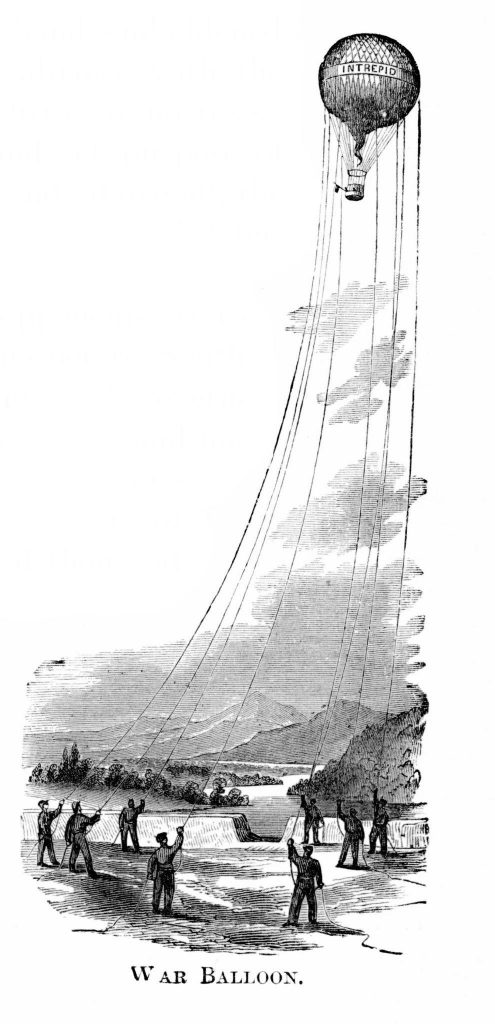
The Union Army deployed several balloons, including Intrepid, Constitution, and Enterprise. These balloons were:
- Filled with hydrogen generated in portable gas generators
- Tethered to the ground with ropes
- Used primarily for reconnaissance and artillery spotting
Observers ascended hundreds to over 1,000 feet above the battlefield. From these heights, they could map Confederate troop positions, track movements in real time, and direct Union artillery fire with improved accuracy.
One of the most innovative aspects of the Balloon Corps was communication. Telegraph wires were sometimes run along the tether lines, allowing observers to transmit battlefield intelligence directly to commanders below. This marked one of the earliest integrations of aviation and real-time battlefield communication in American history.
The Confederacy made limited attempts at balloon use but lacked the industrial capacity to sustain the program. The Union Balloon Corps was disbanded in 1863 due to funding and administrative challenges, yet it remains the first organized military aviation unit in U.S. history.
World War I: Observation Balloons Above the Trenches
By World War I, observation balloons were standard equipment on European battlefields.
France, Britain, Germany, and later the United States used tethered balloons for reconnaissance and artillery direction. These balloons were typically filled with hydrogen and raised to altitudes of 3,000 to 5,000 feet. Observers communicated with artillery units through telephone lines running down the tether cable.
Balloon observers provided critical artillery spotting, enabling gunners to adjust fire with much greater precision. Because of their importance, balloons became prime targets for enemy aircraft. Specialized fighter pilots—sometimes called “balloon busters”—risked intense anti-aircraft fire to destroy them.
It is important to clarify that while balloons were heavily used for observation and artillery correction, they were not commonly used to drop bombs. Strategic bombing during World War I was conducted primarily by airplanes and large airships such as German Zeppelins, not tethered observation balloons.
World War II: Barrage Balloons and Defensive Strategy
During World War II, balloon use shifted primarily to defensive operations.
Rather than serving as reconnaissance platforms, balloons were deployed as barrage balloons over cities, ports, and military installations. These large balloons were tethered by steel cables designed to deter low-flying enemy aircraft.
During the Blitz, Britain deployed thousands of barrage balloons over London and other strategic sites. The cables forced German pilots to fly at higher altitudes, which reduced bombing accuracy and exposed aircraft to anti-aircraft fire. Barrage balloons were also used during the D-Day landings in Normandy to protect Allied ships and troops from low-level air attacks.
Contrary to some popular misconceptions, balloons were not used to deploy paratroopers during World War II. Airborne troops were delivered by aircraft, not tethered balloon systems.
The Vietnam War: Aerostats and Electronic Surveillance
By the Vietnam War, balloon technology had evolved into tethered surveillance systems known as aerostats.
The United States military deployed aerostats equipped with radar and communications equipment to monitor enemy movement, infiltration routes, and airspace activity. These systems could operate at significant altitudes and provided persistent surveillance over wide areas.
Unlike earlier observation balloons, Vietnam-era aerostats were less reliant on human observers in baskets and more focused on electronic detection systems. They represented a transitional stage between traditional balloons and modern airborne surveillance platforms.
Modern Warfare: Persistent Surveillance in the Sky
Today, tethered aerostats remain in use around the world.
Modern systems, such as the U.S. Tethered Aerostat Radar System (TARS), are used for border security, drug interdiction, missile detection, and persistent radar coverage. These platforms can remain airborne for extended periods while carrying advanced radar and sensor equipment.
The advantages of aerostats include:
- Long-duration flight while tethered
- Lower operational costs compared to aircraft
- Stable platforms for radar and surveillance equipment
- Continuous monitoring over fixed locations
Unlike satellites or aircraft, tethered aerostats can remain over a specific area for extended periods, providing constant coverage.
From Hydrogen Balloons to High-Tech Surveillance
The military use of balloons began as a bold experiment during the American Civil War. What started as observers in wicker baskets tethered by ropes evolved into radar-equipped platforms capable of monitoring vast regions.
While modern technology has advanced dramatically, the core principle remains unchanged: elevation provides perspective, and perspective provides intelligence.
From Thaddeus Lowe’s hydrogen balloons over Virginia to modern aerostat surveillance systems, balloons have quietly influenced military strategy for more than a century and a half. Their story is not merely one of innovation—it is a testament to how simple physics and creative thinking reshaped warfare.