
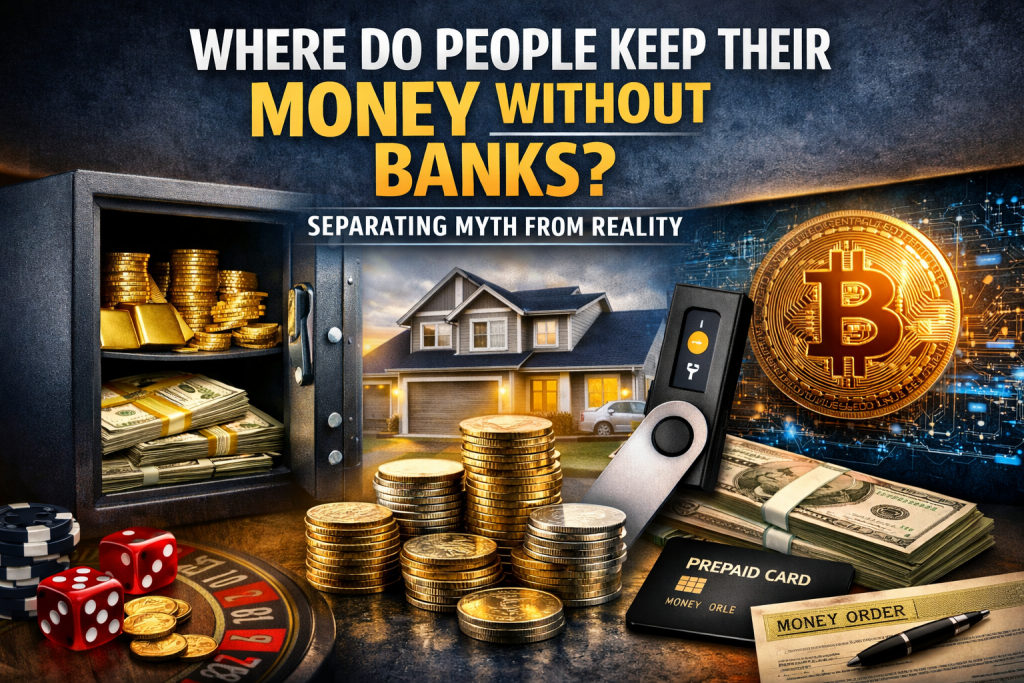
Casinos, Cash, Crypto and Gold: Where Money Really Goes When It Avoids Banks
In recent weeks, I’ve noticed a recurring theme in the questions people have been asking me. If someone doesn’t use a bank, where do they keep their money? Is it true you can keep money in a casino? Is there some kind of loophole where you can just park cash somewhere? Instead of answering everyone individually, I figured I’d address it all in one post.
We live in a system where nearly every financial transaction flows through regulated institutions. Banks, credit unions, brokerages, and payment processors operate under federal oversight. Yet millions of Americans either don’t use traditional banks or actively avoid them.
As someone who pays close attention to financial systems, compliance law, and how money actually moves, I decided to take a closer look at what’s real, what’s myth, and where the gray areas actually are.
The Casino “House Account” Question
One of the more persistent rumors is that you can walk into a casino in Las Vegas, Atlantic City, or on tribal land, deposit a large amount of cash, and treat it like a private vault — withdrawing it later without scrutiny.
Casinos do offer front money accounts. High-limit players can deposit funds with the cage and draw against them later. They also extend credit lines known as markers.
However, casinos are regulated under the Bank Secrecy Act. They are required to file Currency Transaction Reports for cash transactions over $10,000 in a single day and Suspicious Activity Reports if activity appears structured or unusual.
Casinos are not secret offshore banks. They operate under aggressive anti-money-laundering rules. Depositing large sums without gambling activity will almost certainly trigger internal review. There is no hidden casino loophole where people are quietly parking millions.
The Reality of the Unbanked in America
Federal data shows that millions of Americans are either unbanked, meaning they have no checking or savings account, or underbanked, meaning they rely on alternative financial services.
The reasons vary. Some distrust banks. Some owe banks money and cannot open accounts due to ChexSystems records. Some operate in cash-heavy industries. Others prioritize privacy over convenience.
So where does the money go?
Physical Cash Storage
The most common answer is cash held privately. Home safes, hidden compartments, trusted family members, or private storage arrangements are still widely used in cash-based trades and informal economies. The risk is obvious — theft, fire, or loss — but it avoids institutional oversight.
Prepaid Debit Cards and Stored-Value Systems
Prepaid debit cards such as Green Dot or Netspend function similarly to checking accounts without technically being traditional bank accounts. They are regulated as money service businesses, and large transactions remain reportable. They are not invisible, but they provide operational distance from mainstream banking.
Money Orders and Remittance Services
Some individuals store value in money orders or rely on check-cashing and remittance storefronts. These businesses are licensed and regulated under federal compliance rules. They serve communities that do not rely on traditional banking infrastructure. Gray-feeling does not mean unregulated.
Precious Metals: Gold and Silver
For centuries, gold and silver have served as parallel stores of value. Physical bullion held privately is not electronically tracked and does not require a bank account. Large purchases often require identification, and dealers are regulated, but precious metals remain a long-term wealth preservation tool for those seeking independence from digital financial systems.
Real Estate and Tangible Assets
Some convert cash into land, vehicles, equipment, or collectibles. These are stores of value rather than liquid cash equivalents, but they move wealth outside of banking systems.
Cryptocurrency and Hardware Wallets
Cryptocurrency has introduced a modern alternative to traditional banking rails. With a hardware wallet such as a Ledger or Trezor device, an individual can store private keys offline. The assets exist on a blockchain, but control belongs to whoever holds the keys.
From a mobility standpoint, this changes things dramatically. A person can travel internationally carrying a small hardware wallet, or even memorizing a seed phrase, and access funds from anywhere in the world without carrying cash or gold.
Cryptocurrency is not invisible. Blockchain transactions are traceable. Exchanges are regulated. Large on-ramps and off-ramps trigger reporting requirements. It is not a loophole. It is a technological shift.
International Movement of Funds
Moving money internationally traditionally requires bank wires, SWIFT transfers, or currency declarations when physically transporting more than $10,000 in cash. These are monitored.
Cash above $10,000 must be declared when entering or leaving the United States. Undeclared transport can result in seizure. Gold may also require declaration depending on the form and value.
Crypto introduces a peer-to-peer, borderless rail, but it is increasingly regulated at entry and exit points.
The Bottom Line
If someone in the United States is holding significant wealth while avoiding traditional banking, it typically falls into one of these categories: physical cash, precious metals, real estate and tangible assets, cryptocurrency held in self-custody, or alternative financial service products such as prepaid cards.
Nearly every institutional structure that holds money in custody, including casinos, is regulated and subject to federal reporting laws.
The gray market is not a hidden parallel banking system. It is a patchwork of workarounds, tradeoffs, and personal risk tolerance.
Money in America almost always touches regulated infrastructure at some point. Understanding that distinction matters, especially in a time when privacy, control, and financial sovereignty are being discussed more openly than ever.