
The Great Seal Bug: The Cold War Spy Device That Predicted Wireless Charging and RFID
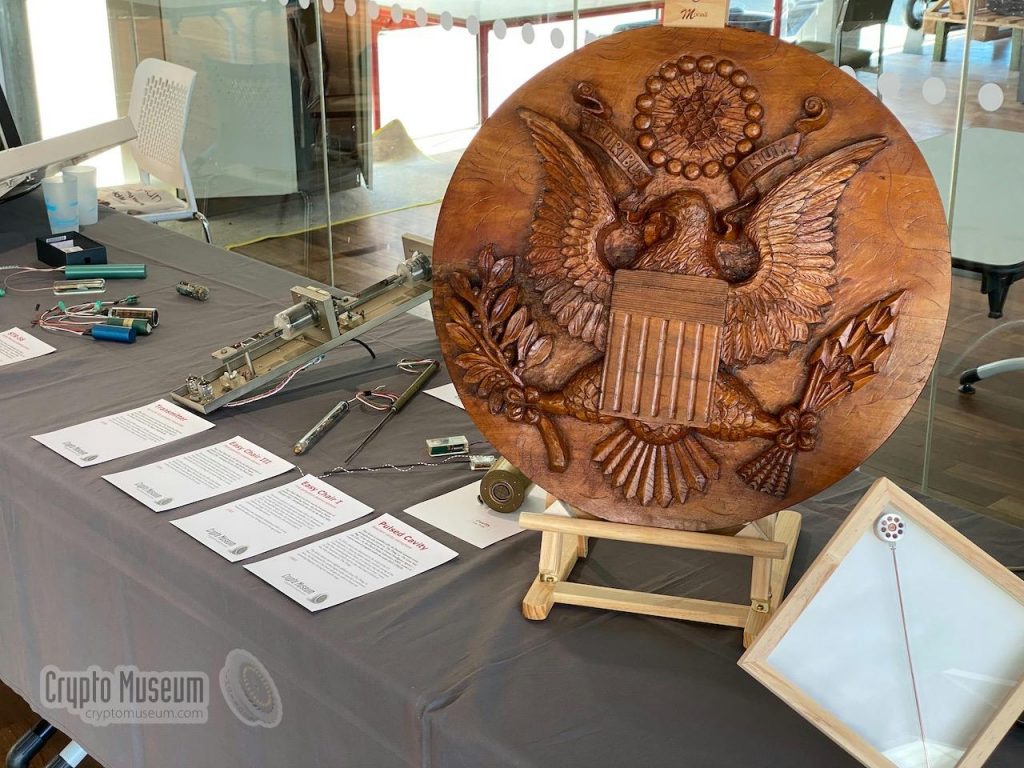
In August of 1945, a group of smiling Soviet schoolchildren presented the American ambassador in Moscow with a hand-carved wooden replica of the Great Seal of the United States. It appeared to be a simple gesture of friendship between wartime allies.
It was actually one of the most ingenious espionage devices ever created.
The carved seal hung in the ambassador’s office for seven years before anyone realized it contained a hidden listening device. The Soviets called it “The Thing.” American intelligence later codenamed it LOSS. What made it remarkable wasn’t simply that it was hidden. It was that it had no battery, no wires, no visible electronics, and yet it successfully transmitted conversations to Soviet intelligence for years. (Wikipedia)
A Bug With No Battery
Most people assume a listening device needs power. Even the smallest modern bug requires a battery or a wired connection.
The Great Seal Bug required neither.
Inside the wooden carving was a resonant cavity microphone, a highly polished metal chamber connected to a thin membrane and antenna. When Soviet operators wanted to listen, they directed a powerful radio signal toward the ambassador’s office from a nearby building or vehicle. The radio energy energized the device, causing it to “wake up.” Voices in the room vibrated the membrane, which altered the reflected radio signal. Soviet receivers then decoded those changes back into speech. (International Spy Museum)
In modern terminology, the bug was being wirelessly powered by radio frequency energy.
That concept should sound familiar.
The Connection to RFID
Today, millions of people use RFID technology every day without realizing it.
When you tap a key card at a hotel, scan a building access badge, use a contactless payment card, or wave a modern transit pass, you are often using a passive RFID device.
Like the Great Seal Bug, passive RFID tags contain no battery. They harvest energy from a radio signal emitted by a nearby reader. That harvested energy powers the tiny chip long enough to transmit information back. The principle is remarkably similar to what Soviet engineer and inventor Leon Theremin developed during the Cold War. (Wikipedia)
The Soviets were effectively demonstrating passive RF-powered electronics decades before RFID became common.
Is It Like Wireless Phone Charging?
Yes and no.
Modern wireless phone chargers typically use magnetic induction. Energy is transferred over a very short distance between coils of wire. Place the phone on the charging pad and electricity flows into the battery.
The Great Seal Bug worked differently.
Instead of charging a battery, it harvested just enough radio energy from a distant transmitter to operate momentarily. A closer modern comparison would be passive RFID, NFC payment systems, or emerging battery-free Internet of Things devices.
Think of it this way:
A wireless phone charger sends enough power to recharge a battery.
The Great Seal Bug only borrowed enough energy to wake up, listen, and reflect information back.
In many ways, it was more efficient.
The Rise of RF Power Harvesting
The principles behind The Thing are still being explored today.
Researchers and engineers are developing battery-free sensors that harvest energy from radio waves, television broadcasts, Wi-Fi signals, cellular towers, and dedicated RF transmitters.
Imagine a sensor in a bridge, a farm field, or a remote location that never needs a battery replacement because it continuously harvests tiny amounts of energy from the radio signals already surrounding it.
These systems are often called RF energy harvesting devices.
While they generate only small amounts of power, advances in ultra-low-power electronics have made them increasingly practical. Some sensors can operate on microwatts of energy—less power than many wristwatches consume. The concept is essentially an evolution of the same idea demonstrated by the Great Seal Bug in 1945. (Wikipedia)
Seven Years Ahead of Its Time
The most astonishing part of the story isn’t that the Soviets bugged the ambassador’s office.
It’s that they did so using technology that many engineers of the day barely understood.
When American and British investigators finally discovered the device, they initially struggled to understand how it worked because there were no batteries, no vacuum tubes, and no obvious source of power. The bug was so advanced for its time that it inspired years of research into similar technologies by Western intelligence agencies. (Crypto Museum)
Today, we casually carry smartphones equipped with wireless charging, Bluetooth, Wi-Fi, NFC, RFID, and multiple radio systems.
But the roots of many of those technologies can be traced back to a simple wooden plaque hanging on a wall in Moscow.
Sometimes the future arrives disguised as a gift.
I think this would fit your audience well because it starts as Cold War history, then pivots into RF engineering, RFID, wireless power transfer, and modern technology without getting so technical that non-engineers tune out.
test
test Houston are we reaching you?