The Red Caps of the Scottish Borders
The Red Caps of the Scottish Borders
Blood-Soaked Spirits of Ruined Castles and Ancient Violence
Long before modern horror stories filled bookshelves and movie screens, the people of the Scottish borderlands told tales of creatures far more unsettling than anything invented today. Hidden among ruined towers, abandoned peel houses, lonely moors, and battle-scarred castles lurked beings known as Red Caps — murderous goblins said to haunt places where violence had stained the land itself.
Unlike the softer and romanticized fairy imagery common in modern culture, the older folklore of Scotland and northern England often portrayed the fae as dangerous, unpredictable, and deeply tied to death, bloodshed, and the unseen world. The Red Cap stands among the darkest of these legends.
The stories were especially common throughout the Scottish Borders, a region that endured centuries of warfare, raids, executions, clan feuds, disappearances, and brutal frontier violence between Scotland and England. In these lands, folklore became intertwined with fear, memory, and survival.
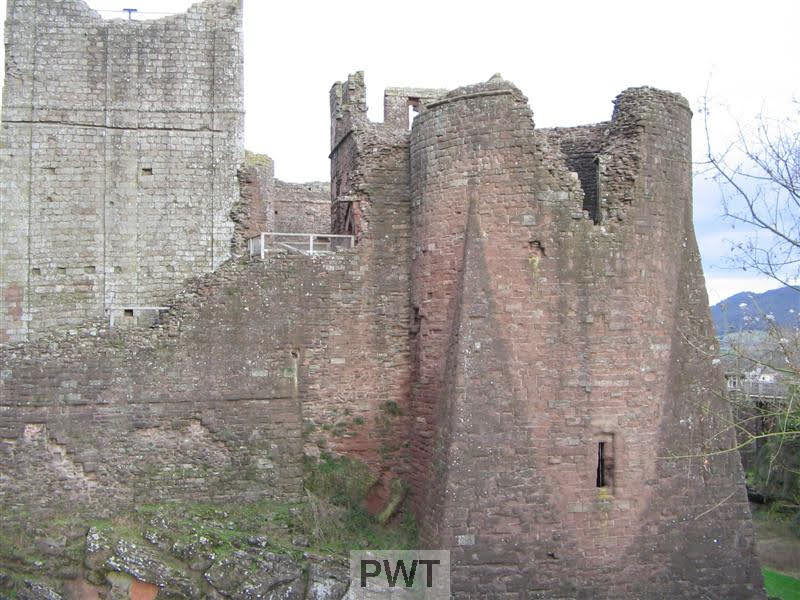
According to traditional accounts, Red Caps dwelled inside ruined castles and isolated towers where terrible deeds had once occurred. Travelers who wandered alone near these ruins after dark risked encountering one of these creatures waiting silently among the broken stone walls.
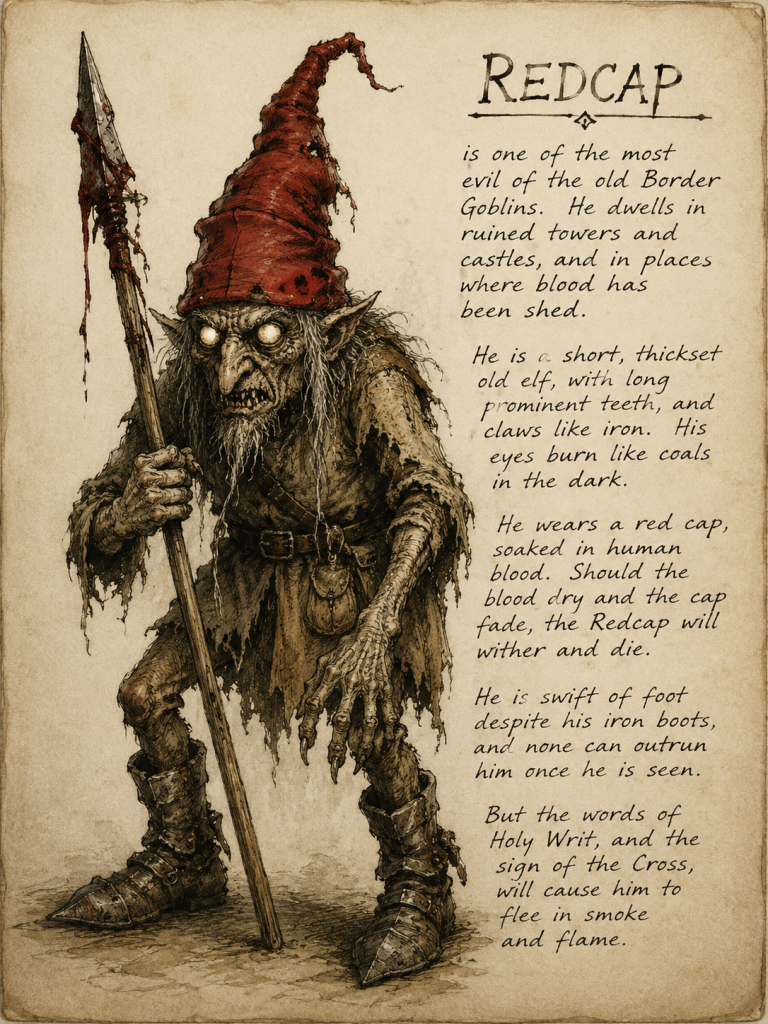
Descriptions varied slightly across different tellings, but most portrayed the Red Cap as a short, thickset goblin-like being with iron boots, long teeth, fiery or glowing red eyes, claw-like fingers, and wild hair hanging around its shoulders. Some stories described them carrying pikes or throwing massive stones down upon unsuspecting travelers.
One of the most important literary descriptions comes from William Henderson’s 1879 folklore collection Notes on the Folk-Lore of the Northern Counties of England and the Borders, where the Red Cap is described as:
“a short, thickset old elf with long prominent teeth.”
That brief line may be the closest thing folklore scholars have to a “canonical” historical description of the creature’s appearance.
Their most horrifying feature, however, was the cap itself.
Folklore claimed the Red Cap soaked its hat in the blood of its victims to keep the fabric crimson red. In many versions of the legend, the creature would weaken and eventually die if the blood on the cap ever dried completely. Murder was not merely cruelty — it was survival.
This grim detail helped cement the Red Cap as one of the most feared supernatural beings in Border folklore.
Many stories also claimed the creatures moved with terrifying speed despite wearing heavy iron boots. Once spotted, escape was said to be nearly impossible. Yet older Christian-influenced traditions added one possible defense: quoting scripture, displaying a cross, or invoking sacred words could supposedly force the Red Cap to flee, vanish in smoke or flame, or release a terrible scream before disappearing.
This blending of ancient folklore with Christian symbolism reflects the changing spiritual landscape of medieval Scotland. Older supernatural beliefs were not erased by Christianity but instead merged with it, creating legends where ancient creatures feared holy power.
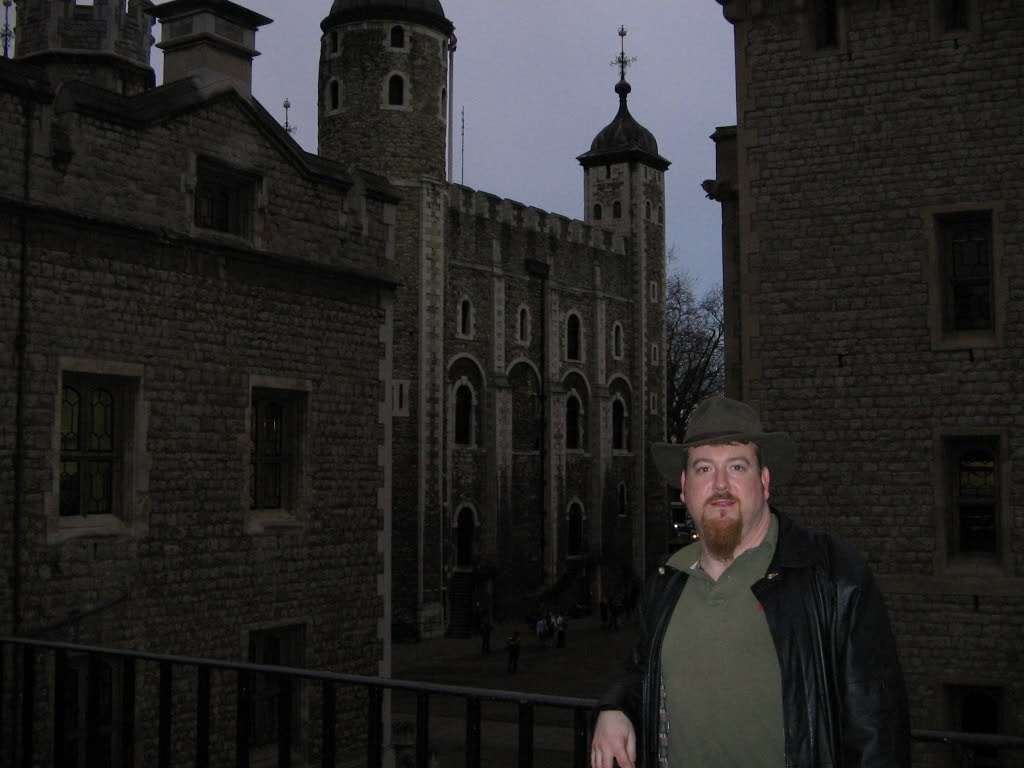
One of the most famous Red Cap traditions involves Hermitage Castle and the infamous nobleman William de Soulis. According to Border legend, Soulis was associated with dark magic and possessed a demonic familiar known as Robin Redcap. Stories claimed the creature assisted him in acts of cruelty and terror around the castle lands. Later folklore alleged that Soulis himself was boiled alive at Ninestane Rig by locals driven beyond endurance by his tyranny, though historical records suggest he actually died imprisoned after political conspiracies during the reign of Robert the Bruce. Even so, the legend endured.C
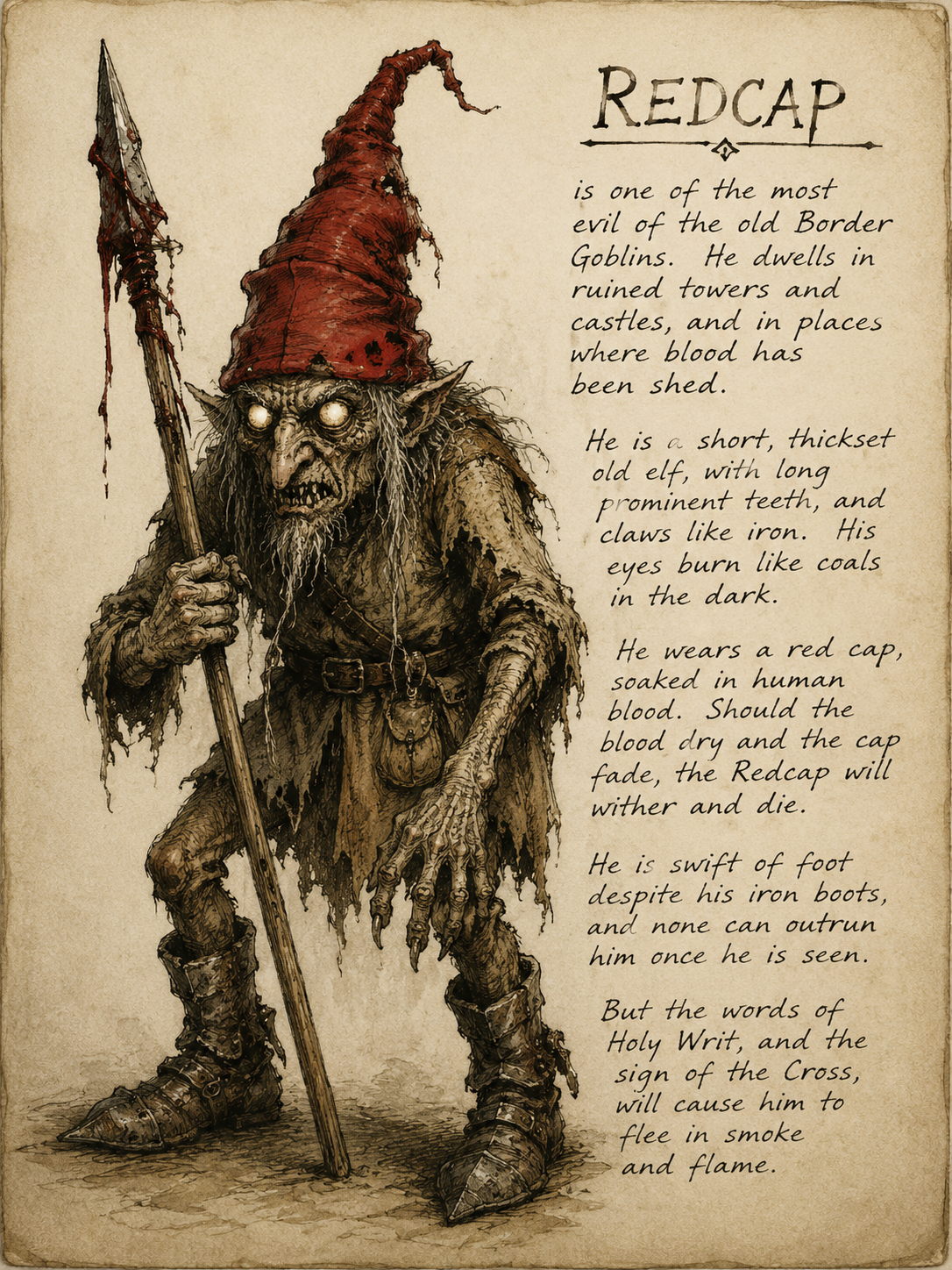
An important detail often lost in modern depictions is that older folklore usually portrayed Red Caps less as giant monsters and more as malicious goblin-like old men or murderous dwarfish border spirits. Modern fantasy art frequently exaggerates them into towering demons or monstrous creatures, while the traditional stories describe something smaller, faster, and perhaps even more unsettling because of its almost human appearance.
Modern illustrations still preserve many traditional folkloric elements:
- ruined Border castles
- iron boots
- spear or pike weapons
- ragged clothing
- glowing or fiery eyes
- crouched predatory posture
- the infamous blood-soaked red cap
Because most early Border folklore was transmitted orally, there are very few truly ancient visual depictions of Red Caps. Most surviving artwork comes from the Victorian folklore revival of the 1800s and early 1900s, when antiquarians, folklorists, and artists began recording oral traditions before they disappeared.
The famous Scottish writer and folklorist Walter Scott helped preserve many of these stories in Minstrelsy of the Scottish Border. Scott famously wrote that nearly every ruined tower in southern Scotland was believed to have a spirit of this kind haunting it.
What makes the Red Cap legend particularly fascinating is how clearly it mirrors the history of the Borderlands themselves. These were not peaceful fairy tales born from comfortable places. The Scottish Borders were once among the most violent regions in Britain. Raiding families known as Border Reivers crossed back and forth through the frontier for generations, stealing livestock, burning homes, kidnapping rivals, and carrying out revenge killings. Entire communities lived with the constant possibility of sudden violence.
The Red Cap may have become the supernatural embodiment of those fears — a physical manifestation of murder lingering in abandoned ruins long after the blood had dried.
Even today, the crumbling castles and lonely hills of the Borders carry an atmosphere that easily fuels such legends. Wind moves through roofless towers, fog settles over ancient stone, and the remnants of old violence remain etched into the landscape itself.
Whether viewed as folklore, cautionary tale, psychological memory, or supernatural tradition, the Red Caps remain one of the most chilling legends ever to emerge from the British Isles.
Literary and Folklore References to the Red Caps:
- Minstrelsy of the Scottish Border — Walter Scott’s famous preservation of Border legends and supernatural traditions.
- Notes on the Folk-Lore of the Northern Counties of England and the Borders (1879) by William Henderson — contains one of the most cited physical descriptions of the Red Cap.
- The Encyclopedia of Fairies — one of the definitive modern scholarly fairy folklore references.
- The Fairy Mythology by Thomas Keightley — includes discussions of darker British fae traditions.
- English Fairy and Other Folk Tales by Edwin Sidney Hartland.
- British Goblins by Wirt Sikes — explores older Celtic supernatural traditions and hostile fae beliefs.
- Several Victorian fairy illustration books and folklore collections from the late 1800s included artistic interpretations of Red Caps during the Gothic revival period.
- Modern fantasy literature, tabletop role-playing games, and horror fiction later adapted the Red Cap into more monstrous forms, though these often drift considerably from the older Border traditions.
Sources and Further Reading:
- Henderson, William. Notes on the Folk-Lore of the Northern Counties of England and the Borders (1879)
- Minstrelsy of the Scottish Border
- The Encyclopedia of Fairies
- The Fairy Mythology by Thomas Keightley
- British Goblins by Wirt Sikes
- Scottish Border folklore archives and oral traditions