
The Public Universal Friend: America’s Forgotten Genderless Evangelist
American history is filled with unusual religious figures, but few are as fascinating, or as overlooked, as the person known as the Public Universal Friend.
Most Americans have never heard the name. Yet in the late 1700s, this individual founded a religious movement, attracted hundreds of followers, established communities in what was then the American frontier, challenged traditional ideas of gender, and left behind a story that still sparks debate more than two centuries later.
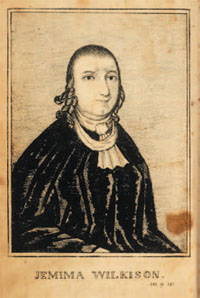
Who Was Jemima Wilkinson?
The story begins with Jemima Wilkinson, born in Rhode Island in 1752. Wilkinson grew up in a Quaker-influenced environment during a period of intense religious revivalism in colonial America.
In 1776, during the American Revolution, Wilkinson became gravely ill. After recovering, Wilkinson claimed that Jemima had died and that a new spiritual being now occupied the body. This new identity was called the Public Universal Friend.
From that point forward, the Friend rejected the name Jemima Wilkinson and refused gendered identity. Followers were instructed not to refer to the Friend as male or female. The Friend taught that the soul itself had no sex and that this new messenger was beyond ordinary earthly categories.
A New Religious Movement
The Public Universal Friend traveled through New England and the Mid-Atlantic preaching repentance, moral reform, spiritual renewal, and preparation for divine judgment.
The movement was influenced by Quaker ideas but became its own religious society known as the Society of Universal Friends.
The Friend’s teachings included spiritual equality, moral discipline, opposition to slavery, simplicity of living, and the belief that God’s message was intended for all people.
What Did “Universal” Mean?
The word “universal” can be misleading to modern readers. Today, many people hear it and think of religious pluralism, interfaith cooperation, or the idea that all religions are equally valid.
That was not necessarily what it meant in the 1700s.
For the Public Universal Friend, “universal” meant that the message was offered to all people. It did not mean that all religions were being blended into one belief system. The Friend preached within a broadly Christian framework, but the message was presented as open to everyone, regardless of denomination, social class, or background.
How Religion Changed After World War II
This is where the story becomes especially interesting.
For much of American history, religion was usually local, denominational, and inherited. A Baptist was Baptist. A Methodist was Methodist. A Presbyterian was Presbyterian. These differences mattered deeply.
Most people learned religion from family, local churches, pastors, printed Bibles, hymnals, and whatever books they could access. Travel was limited. Books were expensive. Many people had little direct exposure to other Christian denominations, much less to non-Christian religions.
That began changing dramatically in the twentieth century.
Radio, television, mass printing, immigration, universities, global travel, and eventually the internet all changed how people encountered religion. Suddenly, beliefs that had once been distant or unknown became accessible.
One major postwar development was the founding of the World Council of Churches in 1948. The council did not teach that all religions were the same, but it did encourage cooperation among Christian denominations that had often viewed one another with suspicion.
After World War II, interdenominational and interfaith dialogue became more common. Many Christians began encountering other traditions in ways their grandparents never had. Access to scripture, religious commentary, comparative religion, and global theology expanded dramatically.
This did not mean all Christians suddenly changed their beliefs. Many did not. But the religious landscape changed. The average person had far more exposure to other denominations and other faiths than earlier generations could have imagined.
A Movement Without a Successor
The Public Universal Friend died in 1819.
Unlike many religious movements, there was no clear successor. The Friend had not built a permanent clergy structure capable of replacing the founder’s unique role.
Followers remained for a time, but the movement gradually declined. Without the central figure who had held it together, the Society of Universal Friends slowly faded away.
Why This Story Still Matters
The Public Universal Friend’s story touches several issues that still feel modern: religious authority, gender identity, spiritual equality, charismatic leadership, and the way movements rise and fall after their founders are gone.
Long before modern debates about gender, the Friend rejected male and female identity.
Long before modern interfaith language, the Friend used the idea of a universal message.
Long before mass media, the Friend built a religious following across multiple communities.
The movement disappeared, but the questions it raised did not.
More than two hundred years later, historians still study the person who claimed that Jemima Wilkinson had died and that the Public Universal Friend had taken their place.
Sources
- Paul B. Moyer, The Public Universal Friend: Jemima Wilkinson and Religious Enthusiasm in Revolutionary America
- Susan Juster, Doomsayers: Anglo-American Prophecy in the Age of Revolution
- Yates County History Center, Penn Yan, New York
- New York State Historical Association materials on the Public Universal Friend
- Library of Congress historical materials on early American religion
- World Council of Churches historical archives, founded 1948
- Encyclopedia of American Religions