
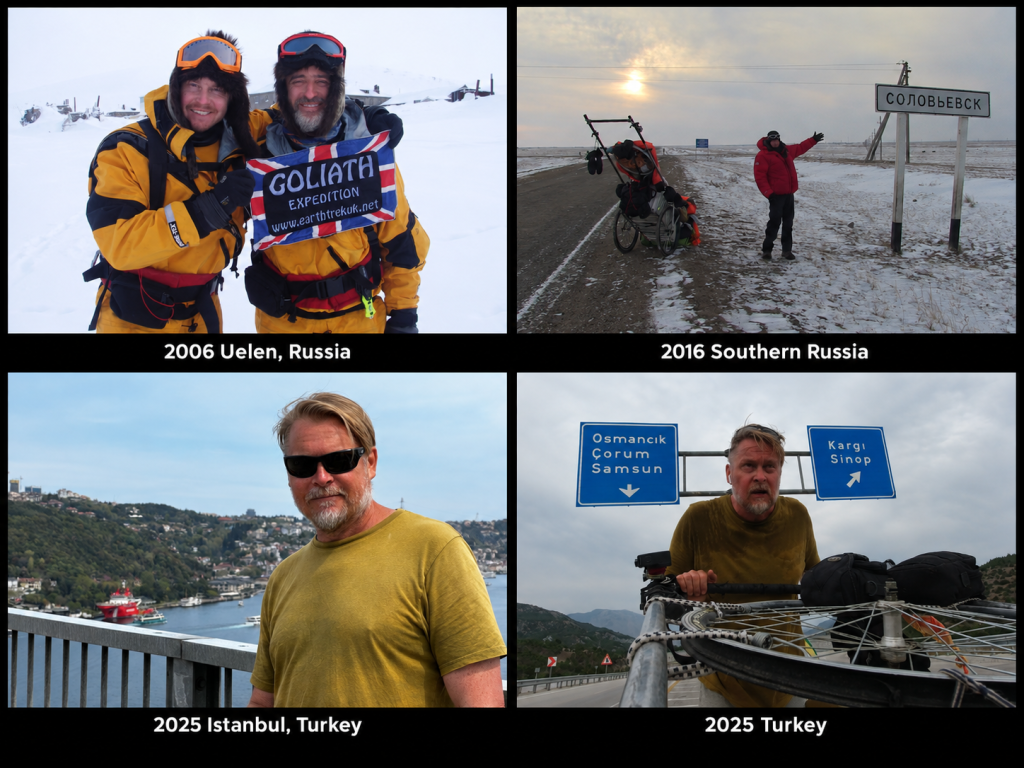
THE MAN WHO HAS BEEN WALKING HOME FOR 28 YEARS
:)>
In 1998, while most of the world was worrying about the approaching millennium, a 29-year-old former British paratrooper stood at the southern end of South America and began walking home.
His name was Karl Bushby. His destination was Hull, England.
Between him and his front door lay tens of thousands of miles, four continents, jungles, deserts, frozen rivers, international borders and two enormous bodies of water. Bushby called his undertaking the Goliath Expedition, and he imposed two uncompromising rules upon himself:
He could not use transportation to advance along his route, and he could not return home until he reached it under his own power.
What was originally expected to take roughly a decade has become one of the longest and most extraordinary expeditions in modern history. Nearly 28 years after leaving Punta Arenas, Chile, Bushby is now approaching his final obstacle: the English Channel.
THE LONG ROAD NORTH
Bushby began walking on November 1, 1998, pushing his equipment in a specially built cart nicknamed “The Beast.”
His route first carried him north through South America. He crossed Chile, Argentina, Peru, Ecuador and Colombia before reaching one of the most dangerous sections of the entire journey—the Darién Gap.
The Darién is a roadless wilderness of dense rainforest, rivers, swamps and mountains separating Colombia from Panama. It has long been associated with armed groups, smugglers, traffickers and kidnappers. Even today, there is no continuous highway through it.
When Bushby entered the region in 2001, Colombia was in the midst of a violent internal conflict involving government forces, paramilitary organizations and the Revolutionary Armed Forces of Colombia, better known as FARC.
Bushby survived the crossing and emerged in Panama, but was jailed for 18 days after entering the country without a visa. It would not be the last time that political borders proved more difficult than the wilderness itself.
He continued through Central America, Mexico and the United States before entering Canada and eventually reaching Alaska.
By 2006, Bushby had traveled more than 17,000 miles under his own power. Ahead of him lay the Bering Strait and one of the most dangerous crossings attempted by any modern explorer.
WALKING FROM ALASKA TO RUSSIA
The Bering Strait separates Alaska from Siberia. At its narrowest point, the two continents are approximately 53 miles apart, but drifting ice, open water and powerful currents make a direct crossing nearly impossible.
In March 2006, Bushby and French adventurer Dimitri Kieffer set out across the frozen strait. Their winding course across moving sea ice covered approximately 150 miles and took 14 days.
They walked, crawled and occasionally swam between shifting slabs of ice. Pressure ridges could rise in their path without warning, while cracks could suddenly expose the freezing ocean below. Their survival depended upon the ice holding together long enough for them to reach Siberia.
They succeeded, becoming the first recorded team to cross the Bering Strait from Alaska to Russia entirely on foot.
Then they were arrested.
Russian authorities detained the men because they had entered the country away from an official border checkpoint. Of course, there was no immigration desk waiting for them on the sea ice. Bushby faced deportation and a possible ban from Russia—a decision that could have ended the entire expedition by permanently breaking his continuous route.
After legal appeals and diplomatic intervention, he was eventually allowed to continue. But the Russian portion of the journey became a bureaucratic battle lasting years.
Visa restrictions limited the amount of time Bushby could remain in Russia. Some sections of Siberia could only be crossed during winter, when frozen rivers became temporary roads. Financial problems following the 2008 economic crisis cost him sponsors, and in 2012 Russian authorities denied him another visa.
In 2013, Bushby walked approximately 3,000 miles from Los Angeles to Washington, D.C., partly to draw attention to his predicament and appeal for help in obtaining permission to continue through Russia.
Eventually, he returned to his route and resumed the long passage across Siberia and Central Asia.
A WORLD THAT KEPT CHANGING
The planet Bushby entered in 1998 was very different from the one through which he travels today.
He began with film cameras, paper maps and no social media. Over the following decades, governments changed, borders tightened, wars began and ended, financial systems faltered, and smartphones transformed how people communicated.
Bushby crossed from Russia into Mongolia in 2017 and later continued through Central Asia. By 2019, he had reached the border region near Turkmenistan and Iran.
Then the route closed again.
Visa difficulties prevented him from moving forward, and the COVID-19 pandemic brought international travel almost to a standstill. Later, the war in Ukraine and deteriorating relations between Russia and Britain made returning through Russian territory increasingly dangerous. Traveling through Iran also presented serious legal and security problems for a British citizen.
The uninterrupted line leading home appeared to have reached an impassable wall.
Bushby’s solution was almost unbelievable: he would swim across the Caspian Sea.
THE 179-MILE SWIM
In August 2024, Bushby entered the Caspian Sea from the coast of Kazakhstan. He was joined by American adventurer Angela Maxwell and supported by swimmers and boat crews from Azerbaijan.
The team followed a route of approximately 288 kilometers, or 179 miles, from Kazakhstan to Azerbaijan.
Bushby and Maxwell generally completed two swimming sessions each day, spending around three hours in the water during the morning and another three hours in the afternoon. They returned to support boats to eat, rest and sleep, but each new swim began where the previous one had ended. The boats provided safety and shelter without carrying them forward along the expedition route.
The crossing took 31 days and required approximately 132 hours in the water.
It allowed Bushby to bypass Russia and Iran without violating the central principle of the Goliath Expedition: every mile of forward progress had to be made under his own power.
From Azerbaijan, he continued through the Caucasus and Turkey. In May 2025, he crossed the Bosphorus in Istanbul, leaving Asia and stepping into Europe.
For the first time in more than a quarter-century, home was beginning to feel close.
THE FINAL ROAD THROUGH EUROPE
Bushby resumed the European leg of the expedition in September 2025, traveling through Bulgaria, Romania, Hungary, Slovakia, Austria and Germany on his way toward France.
Even this comparatively civilized final section presented complications. As a British citizen following Brexit, Bushby was generally limited to 90 days within the European Union’s Schengen Area during any 180-day period. That forced him to interrupt his progress and wait outside the zone before returning to the precise point where he had stopped.
By this time, the expedition had outlasted entire eras of modern life. Children born after he left Chile had grown up, started careers and had children of their own. Bushby had begun with an inexpensive film camera; he was finishing before an online audience following his progress almost in real time.
One body of water still separated him from Britain.
THE LAST OBSTACLE
Bushby originally hoped to receive permission to walk through the Channel Tunnel’s service passage between France and England. That proposal was reportedly rejected because of safety concerns and the disruption it could cause to tunnel operations.
Taking a ferry would violate his rules. After walking, crawling and swimming around the world, he was unwilling to abandon the continuous human-powered path within sight of home.
Once again, he chose the water.
In September 2026, it was reported that Bushby and his support team had secured rare permission from French authorities to attempt an assisted swim across the English Channel. He plans to use a wetsuit, fins and flotation equipment during the crossing, which is expected to take place in October if weather and sea conditions permit.
Once he reaches England, he will still have to walk north to Hull. Current plans call for him to arrive home in November 2026—28 years after leaving Punta Arenas.
NOT QUITE A NONSTOP WALK
Bushby is sometimes described as having walked “nonstop” since 1998, but that is not literally true.
The expedition has included long interruptions caused by finances, visa restrictions, political disputes, seasonal conditions and the pandemic. At times he has temporarily traveled away from the route while waiting for permission to continue.
The important distinction is that he returns to the point where he stopped. No vehicle is used to carry him forward along the expedition line. The path itself remains connected by his footsteps, swimming strokes and other forms of human-powered movement.
That is what Bushby means by an “unbroken footpath.”
He also vowed that he would not simply fly back to Hull during the expedition. Home was not merely his destination on a map. It was the finish line, and he intended to approach it from the road.
A LIFE BUILT AROUND THE NEXT STEP
Bushby’s journey has never been simply a test of how far a person can walk. It has become a study in persistence.
He survived the Darién Gap, crossed the Bering Strait over moving Arctic ice, negotiated his way through Russia, endured deserts and frozen wilderness, lost sponsors, faced visa bans, waited through a pandemic and swam across the Caspian Sea when geopolitics blocked every reasonable land route.
The physical hardships are obvious. The psychological burden may be harder to appreciate.
For nearly three decades, his life has revolved around one objective: keep the route intact and continue toward Hull. Even during the years when he could not walk, the expedition remained unfinished and waiting for him.
Bushby has said that some of the most difficult periods involved monotony—the endless repetition of deserts, tundra and roads that seemed unchanged for days or weeks. He has also spoken about the kindness of strangers, whose food, shelter, assistance and encouragement helped keep the expedition alive.
The greatest lesson of the Goliath Expedition may not be that one exceptionally determined man managed to endure some of the most hostile environments on Earth. It may be that wherever he traveled, ordinary people repeatedly chose to help him.
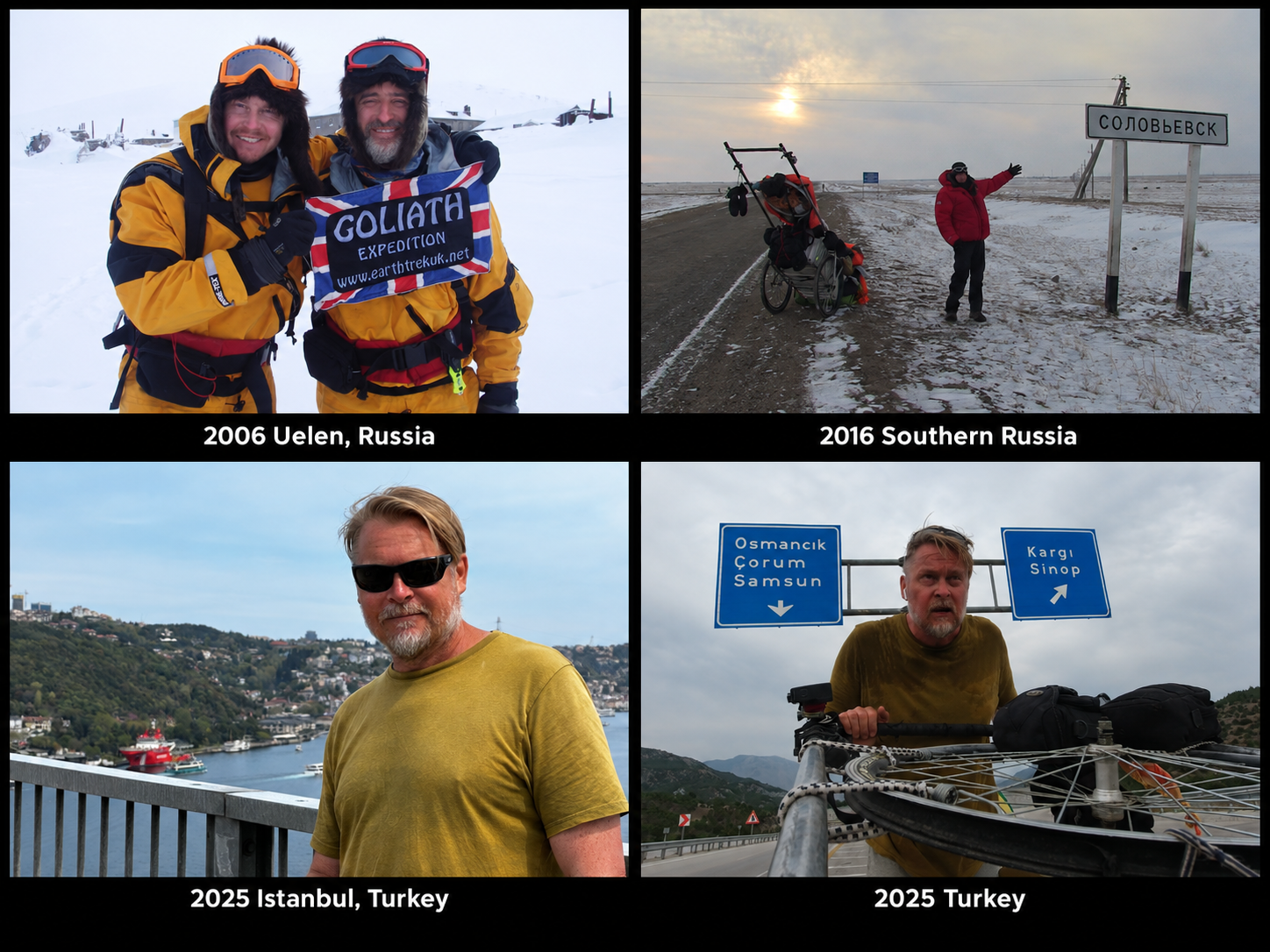
THE WALK HOME
When Karl Bushby left Chile in 1998, Bill Clinton was president of the United States, Tony Blair was Britain’s prime minister, Google had only recently been incorporated, and most people had never owned a mobile phone.
Bushby is returning to a different world—and as a different man.
He is now 57 years old. The 29-year-old former paratrooper who began walking from Punta Arenas has spent nearly half his life trying to reach a front door in Hull.
If the Channel crossing succeeds and the final walk proceeds as planned, the Goliath Expedition will end not with a flag planted on a distant summit, but with something quieter and more human:
A man who left home nearly three decades ago will finally walk back into it.
Sources and further reading:
Reuters, “British globe trekker faces changed world on final leg of 27-year journey”:
https://www.reuters.com/business/media-telecom/british-globe-trekker-faces-changed-world-final-leg-27-year-journey-2025-11-26/
The Times, “Around the world in 28 years: Channel swim is veteran’s last obstacle”:
https://www.thetimes.com/uk/transport/article/around-the-world-in-28-years-channel-swim-is-veterans-last-obstacle-qzkz8s29z
The Washington Post, “He set out to walk around the world. After 27 years, his quest is nearly over”:
https://www.washingtonpost.com/lifestyle/2025/12/05/karl-bushby-walk-around-world/
Karl Bushby’s official Instagram:
https://www.instagram.com/bushby3000/