September 16, 1920 — The Wall Street Bombing
September 16, 1920 — The Wall Street Bombing
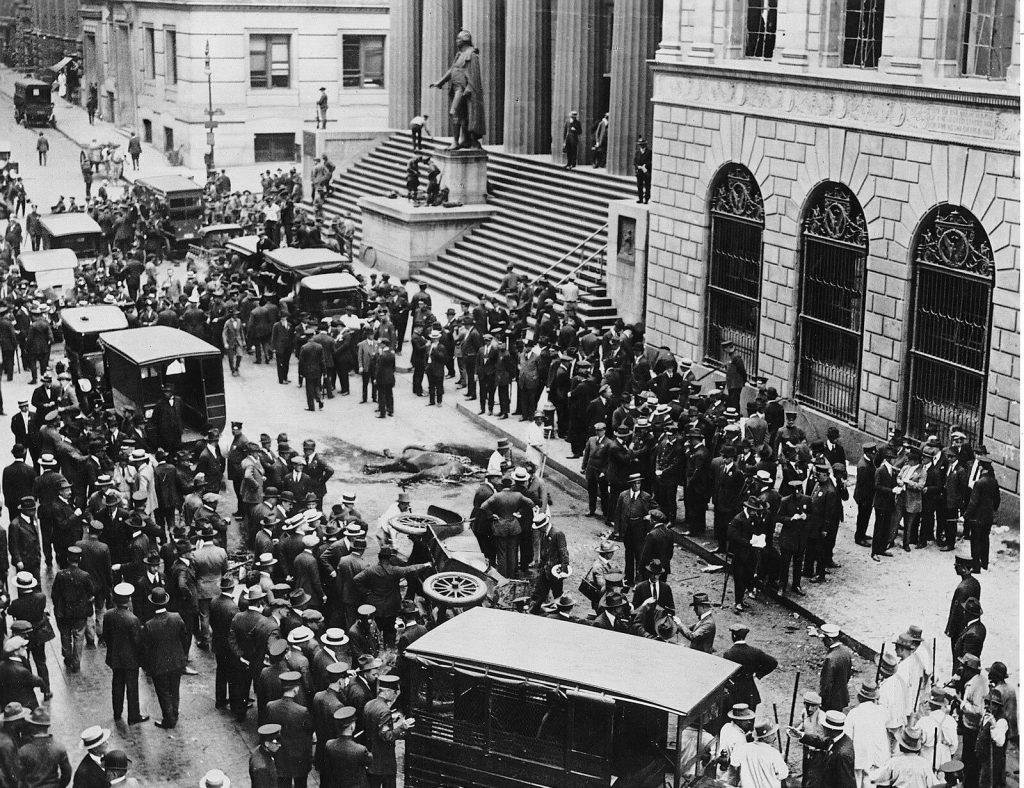
At 12:01 p.m., during the busy lunchtime rush, a horse-drawn wagon loaded with about 100 pounds of dynamite and hundreds of pounds of iron weights exploded outside the J.P. Morgan Building on Wall Street. The iron pieces became deadly shrapnel, tearing through workers, messengers and pedestrians. Thirty people died immediately, eight more later died from their wounds, and hundreds were injured.
The location was almost certainly deliberate. J.P. Morgan & Co. and Wall Street represented American banking, wealth and capitalism. Investigators suspected followers of Italian anarchist Luigi Galleani, who believed violence could ignite revolution and destroy the capitalist system. Anarchist leaflets discovered nearby demanded the release of political prisoners, but no group formally claimed responsibility.
The bombing is sometimes called the first modern “car bomb,” although it was actually carried in a horse-drawn wagon. Earlier carriage bombs had been attempted—including one against Napoleon in 1800—so it was not literally the first. It also had no connection to Ireland or the later IRA car-bomb campaigns.
Despite an extensive investigation, no one was ever convicted. The identity of the bomber, the precise motive and even whether J.P. Morgan himself was the intended target remain uncertain. More than a century later, the Wall Street bombing remains officially unsolved. FBI history