When the Sun Went Dim: What the Disaster of 536 Could Do to the Modern World
Volcanoes are erupting around the planet today. Most will remain regional disasters—but history records what happened when volcanic pollution reached the stratosphere, dimmed the sun and helped push much of the Northern Hemisphere into years of cold and hunger.
In the year 536, the sun did not literally disappear—but to the people living beneath an eerie veil in the sky, it must have seemed as though something had gone terribly wrong with the heavens.
The Byzantine historian Procopius wrote that the sun gave off its light without brightness, almost like an eclipse. The Roman statesman Cassiodorus described a bluish sun, a moon without its usual brilliance, no ordinary shadows at noon and seasons that appeared to have become confused. Summer brought little warmth. Crops failed. Ancient Irish records speak of a failure of bread, while Chinese chronicles record abnormal cold and summer snow.
For centuries, those accounts were treated mainly as mysterious observations from a poorly understood age. Modern science eventually found physical evidence behind them. Tree rings from Europe, Ireland, Scandinavia, Asia and North America show extremely poor growth beginning in 536. Ice cores preserve layers of volcanic material and sulfate deposited during the same period.
The best-supported explanation is that one or more enormous eruptions injected sulfur dioxide high into the atmosphere. There it formed tiny sulfate aerosols that reflected and scattered sunlight before it could warm Earth’s surface. Another major eruption followed around 540, with additional volcanic activity later in the decade.
Researchers now describe the broader cooling interval from approximately 536 to 660 as the Late Antique Little Ice Age. That does not mean the entire planet endured 124 continuous years of darkness. It means a cluster of large eruptions initiated an unusually cold period that was prolonged by additional eruptions and natural climate variability.
The location of the volcano responsible for the first event remains debated. Evidence from a Swiss glacier has been interpreted as pointing toward Iceland for the 536 eruption, while other work has examined possible tropical sources for eruptions during the 530s and 540s. What is no longer seriously disputed is that a major atmospheric event occurred and that it produced widespread climatic effects.
Then Came Hunger—and Plague
A dim sun was not merely frightening. In an agricultural world, sunlight and predictable seasons were life itself.
Reduced sunlight, colder summers and untimely frost shortened growing seasons. Grain could not ripen normally. Livestock suffered when fodder became scarce. Communities had little capacity to import enormous quantities of food from the other side of the planet, and they possessed no modern refrigeration, synthetic fertilizer or global forecasting system.
Then, in 541, the Plague of Justinian reached the Byzantine world. Genetic evidence has established that the disease was caused by Yersinia pestis, the same bacterial species responsible for the medieval Black Death. Contemporary writers described enormous mortality in Constantinople and elsewhere, although their precise daily death counts cannot be verified.
The eruption did not manufacture the plague bacterium, and historians continue debating exactly how climate affected its spread. Nevertheless, disease arrived in societies already strained by poor harvests, displacement, war and hunger. The Byzantine Empire survived, but its resources and Justinian’s attempt to restore Roman control in the West suffered badly.
Farther north, sixth-century Scandinavia experienced abandoned farms, demographic contraction and extraordinary deposits of gold objects. Some researchers believe these valuables were offerings made during a desperate appeal for the return of the sun. The terrible winter remembered in the Norse story of Fimbulwinter—the long winter preceding Ragnarök—may preserve a distant cultural memory of the catastrophe. It is a compelling possibility, but not a proven fact.
Across the Atlantic, the great city of Teotihuacan entered a period of drought, unrest and destruction during approximately the same century. Elite and ceremonial buildings were deliberately burned. Climate stress may have contributed, but it would be an exaggeration to claim that the eruption of 536 single-handedly destroyed Teotihuacan—or any other civilization.
The real lesson is subtler: climate shocks do not need to destroy societies directly. They magnify weaknesses that are already present.
Volcanoes Are Erupting Now—but That Does Not Mean Another 536 Has Begun
As of September 2026, numerous volcanoes are in eruption or showing continuing eruptive activity. The Smithsonian Institution and U.S. Geological Survey weekly report for September 10–16 listed activity at volcanoes including Krakatau and Ibu in Indonesia, Kīlauea in Hawaii, Klyuchevskoy and Krasheninnikov in Russia, Aira in Japan, Kanlaon in the Philippines and Great Sitkin in Alaska.
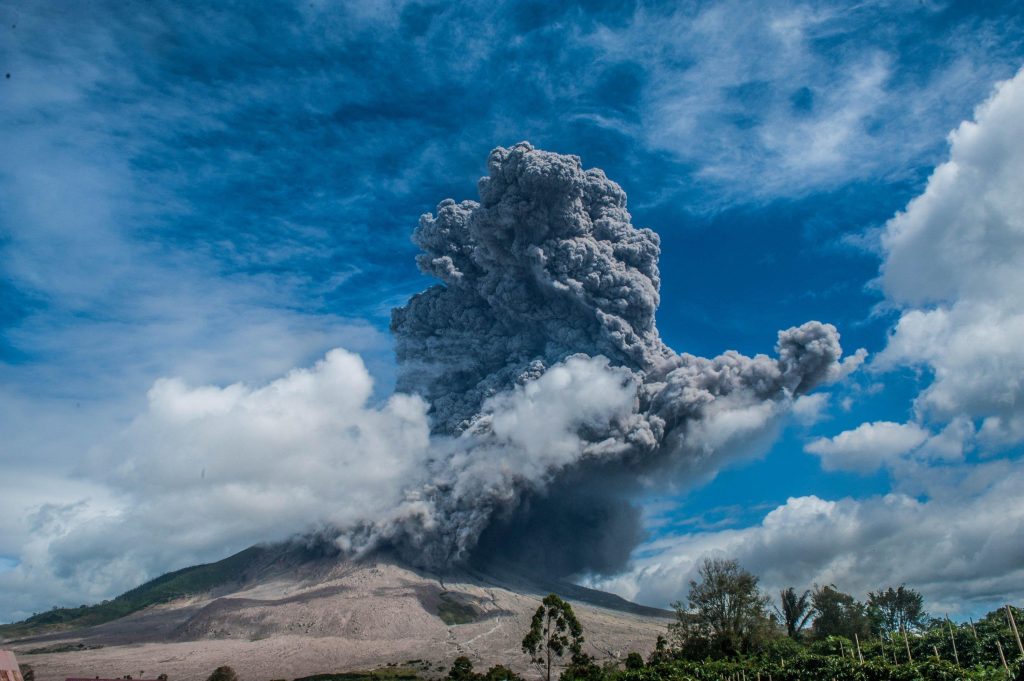
Indonesia has supplied some of the most dramatic recent examples. Anak Krakatau sent ash high enough to close eight airports and affect more than 340,000 travelers in early September. Mount Ibu and Ili Lewotolok also erupted, while Mount Sinabung produced its first eruption in roughly five years at the end of August.
Those events are serious, especially for people living nearby and for aircraft crossing ash-contaminated airspace. They do not, however, mean that Earth is entering another volcanic winter.
There are usually many volcanoes erupting somewhere on Earth. The number erupting at once is less important than their explosiveness, location, sulfur content and the altitude reached by their emissions. Ash that falls out of the lower atmosphere can devastate communities and disrupt aviation without substantially altering global climate. To cool the planet for years, an eruption generally must drive a very large quantity of sulfur dioxide into the stratosphere, where rain cannot quickly wash it away.
The 1991 eruption of Mount Pinatubo in the Philippines provides a modern example. NASA estimates that Pinatubo injected about 15 million tons of sulfur dioxide into the stratosphere. The resulting aerosol layer reduced incoming solar energy and temporarily cooled global surface temperatures by roughly half a degree Celsius. Pinatubo was a major global climate event, yet it was still far less socially devastating than the sequence beginning in 536.
What Would a 536-Scale Event Do Today?
We are technologically stronger than the societies of the sixth century. We can observe eruptions by satellite, model aerosol movement, issue aviation warnings, transport grain between continents and identify pathogens in laboratories. Those capabilities would save millions of lives.
At the same time, modern civilization contains vulnerabilities that Cassiodorus could never have imagined.
Solar Power Would Weaken When It Was Needed Most
Solar panels generate electricity from light, so a volcanic aerosol veil would reduce their output. They would not become completely useless: photovoltaic panels can use diffuse light that has been scattered through the atmosphere. But less sunlight reaching the surface means less electricity produced.
After Pinatubo, researchers measured notable reductions in direct solar radiation at widely separated locations. A larger or repeated series of sulfur-rich eruptions could depress solar generation across broad regions for months or years. Utilities would have to replace that missing power with stored energy, nuclear generation, hydroelectricity, natural gas, coal or other dispatchable sources.
There would also be two different volcanic threats to solar infrastructure. Stratospheric aerosols could cause a widespread reduction in sunlight, while falling ash near an eruption could physically cover panels, abrade surfaces, contaminate equipment and sharply reduce local output until the panels were safely cleaned.
A home with solar panels and a battery would therefore be better prepared than a home with no independent power—but it would not be immune. A system designed around several bright days could struggle through weeks of unusually dim skies, especially while also powering electric heat. The resilient system would combine solar with adequate storage, energy conservation and a second dependable source of generation.
Food Would Become the Central Crisis
The greatest danger would probably not be darkness. It would be simultaneous harvest failures across several major agricultural regions.
Modern crops are highly productive but depend on carefully timed seasons, predictable rainfall, fertilizer, fuel, machinery, electricity and global transportation. Several cold summers could reduce wheat, corn, rice and soybean production at the same time. Frosts could arrive after planting or before harvest. Reduced sunlight would slow photosynthesis even where crops escaped freezing.
International trade could initially move food from unaffected areas to damaged ones. But if multiple breadbaskets failed together, governments would likely restrict exports to protect their own populations. Prices would rise long before supermarket shelves became empty. Poor countries and poor households would be hit first, followed by livestock producers, food processors and industries dependent on agricultural commodities.
Aviation and Global Shipping Would Suffer
Volcanic ash can damage jet engines, obscure visibility and contaminate aircraft systems. The recent Anak Krakatau eruption demonstrated how one ash plume can close airports, ground aircraft and disrupt hundreds of thousands of journeys.
A truly enormous eruption could close major air corridors for days or weeks. Cargo would be diverted to other airports or shifted to ships, rail and trucks. Fresh food, medicine, semiconductor components and other time-sensitive goods would be delayed. The economic damage would travel far beyond the countries receiving ashfall.
The Electrical Grid Would Face Competing Pressures
Reduced solar production would be only one problem. Colder weather would increase demand for heating at the same time that snow, ice or ash threatened transmission equipment. Hydroelectric production might rise in some regions and fall in others as precipitation patterns changed. Wind generation would continue, but weather shifts would alter where and when it was available.
The danger would not be that every power source suddenly stopped. It would be that several stresses arrived together: lower renewable output in some regions, record heating demand, fuel-delivery problems, damaged infrastructure and industries competing for limited electricity.
Information Would Move Faster Than the Disaster
In 536, people could interpret the dimmed sun as a divine warning because no one could show them a satellite image of the eruption or explain stratospheric chemistry.
Today, the physical cause would probably be identified quickly. But social media would produce its own emergency. Fabricated eruption footage, false predictions, conspiracy theories and premature claims of extinction would spread globally within hours. Panic buying could empty stores before any actual shortage reached them. Trust in scientific agencies and governments would become part of the survival infrastructure.
Are Today’s Eruptions a Warning?
Yes—but not because four or ten volcanoes happen to be active at the same time.
They are a warning because the machinery capable of changing the climate still exists beneath our feet. Most eruptions will never affect global temperature. Even spectacular lava fountains and towering ash clouds do not necessarily indicate a climate-changing event. The crucial question is whether an eruption injects an exceptional amount of sulfur into the stratosphere.
There is currently no evidence that the ongoing eruptions collectively represent a repeat of 536. The responsible response is awareness, not panic.
Still, the year 536 exposes a weakness in the modern promise that technology has freed us from nature. Solar panels, global trade, precision agriculture and just-in-time delivery are remarkable achievements, but they are systems built around expected conditions. Remove enough sunlight, disrupt several harvests and close important transportation routes at once, and their efficiencies can become vulnerabilities.
Our ancestors watched a pale sun and had no idea why their world had changed. We would understand the physics almost immediately. The harder question is whether understanding the catastrophe would make us sufficiently prepared to endure it.
Sources and Further Reading
Ulf Büntgen and others, “Cooling and Societal Change During the Late Antique Little Ice Age from 536 to Around 660 AD,” Nature Geoscience (2016):
https://www.nature.com/articles/ngeo2652
Michael McCormick and others, “The Ice-Core Perspective on the Economic History of European Lead and Silver Production,” Antiquity (2018):
https://doi.org/10.15184/aqy.2018.110
Smithsonian Institution and U.S. Geological Survey, Weekly Volcanic Activity Report, September 10–16, 2026:
https://volcano.si.edu/reports_weekly.cfm
NASA, “Global Effects of Mount Pinatubo”:
https://science.nasa.gov/earth/earth-observatory/global-effects-of-mount-pinatubo-1510/
U.S. Geological Survey, “The Atmospheric Impact of the 1991 Mount Pinatubo Eruption”:
https://pubs.usgs.gov/pinatubo/self/
Reuters, “Indonesia Reopens All Airports as Anak Krakatau Ash Clears,” September 8, 2026:
https://www.reuters.com/business/environment/indonesia-reopens-jakarta-airport-four-others-after-anak-krakatau-ash-clears-2026-09-08/