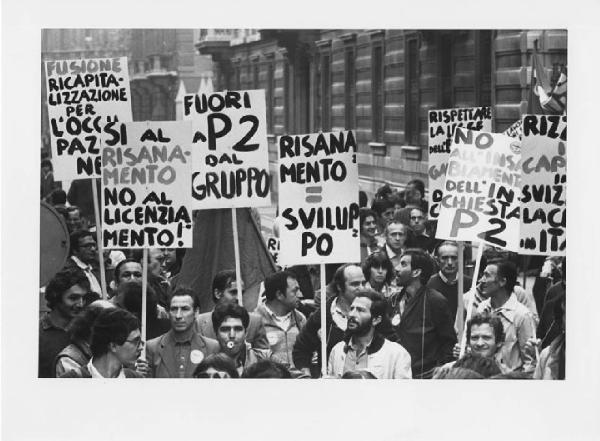
P2: The Secret Lodge That Infiltrated the Italian State
In March 1981, Italian financial police searching the home and offices of businessman Licio Gelli uncovered something extraordinary: a list containing the names of hundreds of military officers, intelligence chiefs, politicians, bankers, judges, journalists and business leaders.
They were connected to Propaganda Due—better known as P2—a secret organization operating behind the respectable appearance of a Masonic lodge.
The discovery exposed a hidden network reaching into the highest levels of the Italian state. Its members included the commanders of Italy’s intelligence services, senior military and police officials, members of Parliament, government ministers and influential media figures.
It was not simply another political corruption case. P2 appeared to have built something resembling a shadow government.
In March 1981, Italian financial police searching the home and offices of businessman Licio Gelli uncovered something extraordinary: a list containing the names of hundreds of military officers, intelligence chiefs, politicians, bankers, judges, journalists and business leaders.
They were connected to Propaganda Due—better known as P2—a secret organization that had developed within Italian Freemasonry before separating from its official structure and continuing underground.
The discovery exposed a hidden network reaching into the highest levels of the Italian state. Its members included the commanders of Italy’s intelligence services, senior military and police officials, members of Parliament, government ministers and influential media figures.
It was not simply another political corruption case. P2 appeared to have built something resembling a shadow government.
What Was Propaganda Due?
To understand P2, it is important to understand that Freemasonry is not one single worldwide organization controlled from one headquarters. It is made up of many local lodges, governing bodies known as grand lodges or grand orients, different Masonic rites, and various related organizations. These bodies may share traditions and symbols while remaining administratively separate.
A Masonic lodge is the basic local organization in which members meet. Lodges generally operate under a larger governing body that grants them recognition and establishes rules concerning membership, meetings and conduct.
Propaganda Due was originally one of these lodges.
Its predecessor, known as Propaganda Massonica, was established in the 19th century for members whose prominent positions or travel made participation in an ordinary local lodge difficult. Because its membership included politicians, military officers, diplomats and other public figures, their identities were treated with greater confidentiality than those of ordinary lodge members.
That special arrangement gave the lodge an unusual degree of secrecy from the beginning.
After Freemasonry was suppressed under Benito Mussolini’s Fascist government, the lodge disappeared along with Italy’s other recognized Masonic organizations. It was later revived after World War II and eventually became known as Propaganda Due, or Propaganda Two—abbreviated P2.
P2 initially operated within the Grand Orient of Italy, one of the country’s principal Masonic governing bodies. It was therefore not originally an imitation lodge or an outside organization merely borrowing Masonic symbols. It had a genuine institutional connection to organized Italian Freemasonry.
Under Licio Gelli, however, P2 became something very different.
Gelli was a former fascist who had served with forces supporting Mussolini’s regime during World War II. After the war, he became a businessman and developed connections throughout Italian politics, finance, the military and the intelligence services.
Rather than functioning like an ordinary lodge devoted primarily to Masonic fellowship, philosophy and charitable activity, Gelli used P2 to recruit strategically placed individuals and connect them through a confidential network of influence.
Its members were not simply meeting to participate in ceremonies or discuss Masonic teachings. Many held positions from which they could influence government policy, intelligence operations, military decisions, banking, criminal investigations and the national media.
The secrecy operated on several levels. The general public did not know who belonged to P2, many members of the wider Masonic community did not know the extent of its activities, and government institutions did not know how deeply the network had penetrated their leadership.
P2 was effectively concealing itself both from the Italian people and from much of organized Freemasonry.
This distinction matters because P2 should not automatically be treated as representative of every Freemason or Masonic lodge. Freemasonry contains numerous lodges, rites and related bodies, most of which had no involvement with P2. Italian Masonic leaders eventually moved against Gelli, and the Grand Orient of Italy withdrew P2’s official recognition in 1976.
But losing recognition did not end the organization.
Gelli continued maintaining membership records, recruiting influential people and operating the network in secret. P2 retained Masonic titles, symbols, rituals and personal connections while functioning outside the control of recognized Masonic authorities.
It had evolved from an officially recognized lodge into a clandestine political organization wearing a Masonic identity.
That is what made P2 so dangerous. It could use the privacy, loyalty and ceremonial structure associated with a lodge while pursuing objectives that went far beyond legitimate Masonic activity.
Italy’s Constitution protects freedom of association, including the right of people to join private fraternal organizations. It prohibits, however, secret associations that conceal their membership and pursue political objectives through hidden structures.
P2’s scandal was therefore not based merely on the fact that prominent Italians were Freemasons. The central issue was that these men belonged to an undisclosed network that crossed institutional boundaries and appeared to be coordinating political influence outside democratic oversight.
When investigators uncovered P2 in 1981, they were not simply revealing the membership of an unusually private fraternity. They were exposing a secret power structure that had grown inside recognized Italian Freemasonry, broken away from its supervision and embedded itself inside the Italian state.
The Raid That Exposed P2
On March 17, 1981, investigators raided Gelli’s Villa Wanda estate near Arezzo while examining the financial activities of banker Michele Sindona.
Inside, they discovered documents and a membership list containing approximately 962 names.
The list included:
- Senior generals and admirals
- Officers of the Carabinieri and financial police
- The leaders of Italy’s principal intelligence agencies
- Members of Parliament and government officials
- Bankers and corporate executives
- Newspaper editors and journalists
- Judges and other public officials
- Future Italian prime minister Silvio Berlusconi, who was then a businessman
The list demonstrated that P2 had not been operating at the fringes of society. It had recruited people positioned inside the institutions responsible for defending Italian democracy.
When the government released the names in May 1981, the resulting scandal helped bring down Prime Minister Arnaldo Forlani’s government.
The “Plan for Democratic Rebirth”
Among P2’s most revealing documents was the Piano di rinascita democratica, or “Plan for Democratic Rebirth.”
Despite its democratic-sounding title, the plan described a strategy for reshaping Italian society by placing trusted people in influential positions. It envisioned weakening labor unions, reorganizing political parties, changing the Constitution, restricting the power of the judiciary and increasing control over newspapers and television.
The objective was not necessarily a traditional military coup with tanks in the streets. P2 proposed something quieter: capturing the institutions of democracy from within and gradually redirecting them.
Control of information was especially important. The plan recognized that influence over newspapers, television networks and public opinion could be as powerful as control over government ministries.
This made P2 unusually modern. Its program anticipated a form of political power built through media ownership, financial pressure, institutional appointments and networks of personal loyalty.
Banco Ambrosiano and “God’s Banker”
The P2 scandal became closely connected to one of Europe’s most notorious banking disasters.
Roberto Calvi, chairman of Banco Ambrosiano and a P2 member, was known in the press as “God’s Banker” because of his financial relationship with the Vatican’s bank, officially called the Institute for the Works of Religion.
Banco Ambrosiano used a complicated system of offshore companies, secret loans and questionable transfers. When the bank collapsed in 1982, it left a financial hole exceeding $1 billion.
Calvi fled Italy. On June 18, 1982, he was found hanging from scaffolding beneath Blackfriars Bridge in London. Bricks had been placed in his pockets, and he was carrying a large amount of cash in several currencies.
His death was initially treated as suicide, but later investigations concluded that he had been murdered. Several people were tried, but no one was ultimately convicted of killing him.
The name “Blackfriars” attracted particular attention because members of P2 reportedly referred to themselves as frati neri—“black friars” or “black brothers.” Whether Calvi’s location was deliberately chosen as a message remains unresolved.
The Banco Ambrosiano affair connected P2 to a murky world involving offshore finance, the Vatican bank, organized crime, political money and covert international operations.
Terrorism and the “Strategy of Tension”
The P2 story unfolded during Italy’s Years of Lead, a period marked by political violence, kidnappings, assassinations and terrorist bombings by extremist groups of both the left and right.
P2 has repeatedly been discussed in connection with the so-called “strategy of tension”—the theory that extremist violence was encouraged or manipulated to create fear, discredit the political left and persuade the public to accept stronger authoritarian government.
The deadliest attack of the period occurred at Bologna’s railway station on August 2, 1980, killing 85 people and injuring more than 200.
Courts convicted members of a neo-fascist terrorist organization of carrying out the bombing. Licio Gelli and P2-connected intelligence officials were later convicted of helping misdirect the investigation.
That does not mean every crime attributed to P2 was proven in court. Over the years, the lodge has been linked—sometimes through evidence and sometimes through disputed allegations—to terrorism, attempted coups, Mafia activity, political assassinations and clandestine Cold War operations.
Separating established facts from speculation is essential. What is beyond dispute, however, is that P2 members occupied sensitive positions and that some participated in efforts to obstruct major criminal investigations.
The Parliamentary Investigation
Italy established a parliamentary commission led by Tina Anselmi, a former resistance fighter and the first woman to serve as an Italian cabinet minister.
After examining the organization, the commission concluded that P2 was not merely a private club. It represented a concealed political and criminal system operating inside the state.
Parliament dissolved P2 through legislation enacted on January 25, 1982, and strengthened restrictions against similar secret associations.
The parliamentary investigation produced an enormous historical record. Its work remains one of the most important official examinations of hidden political power in modern Europe. The Italian Chamber of Deputies now provides public access to much of the commission’s surviving documentation through its Parliamentary Commissions of Inquiry archive.
What Happened to Licio Gelli?
Gelli escaped from custody in Switzerland in 1983 and remained a fugitive for several years. He was eventually extradited to Italy and faced numerous prosecutions.
He was convicted of financial crimes associated with the Banco Ambrosiano collapse and of helping obstruct the Bologna bombing investigation. Despite the extraordinary scope of the scandal, Gelli spent relatively little time in an ordinary prison and lived much of his later life under house arrest at Villa Wanda.
He died in 2015 at the age of 96.
Why the P2 Scandal Still Matters
The P2 affair sounds like the plot of a political thriller: a secret lodge, intelligence chiefs, generals, bankers, missing money, the Vatican, the Mafia, terrorist attacks and a banker found hanging beneath a London bridge.
But the central scandal was not a theory. The membership list existed. The secret political plan existed. The parliamentary investigation existed. Senior officials really had joined a concealed organization led by Licio Gelli.
Many of the darker allegations surrounding P2 remain contested or unresolved. That uncertainty has helped turn the lodge into fertile ground for conspiracy theories. Yet the proven facts are disturbing enough without exaggeration.
P2 demonstrated that a democratic government does not have to be overthrown in a single dramatic coup. It can also be weakened gradually when secret networks gain influence over intelligence agencies, finance, law enforcement, politics and the media.
More than four decades after its exposure, Propaganda Due remains a warning about concentrated power operating without transparency or democratic accountability.
The greatest danger posed by P2 was not that it existed completely outside the Italian government.
It was that so much of it had already gotten inside.