
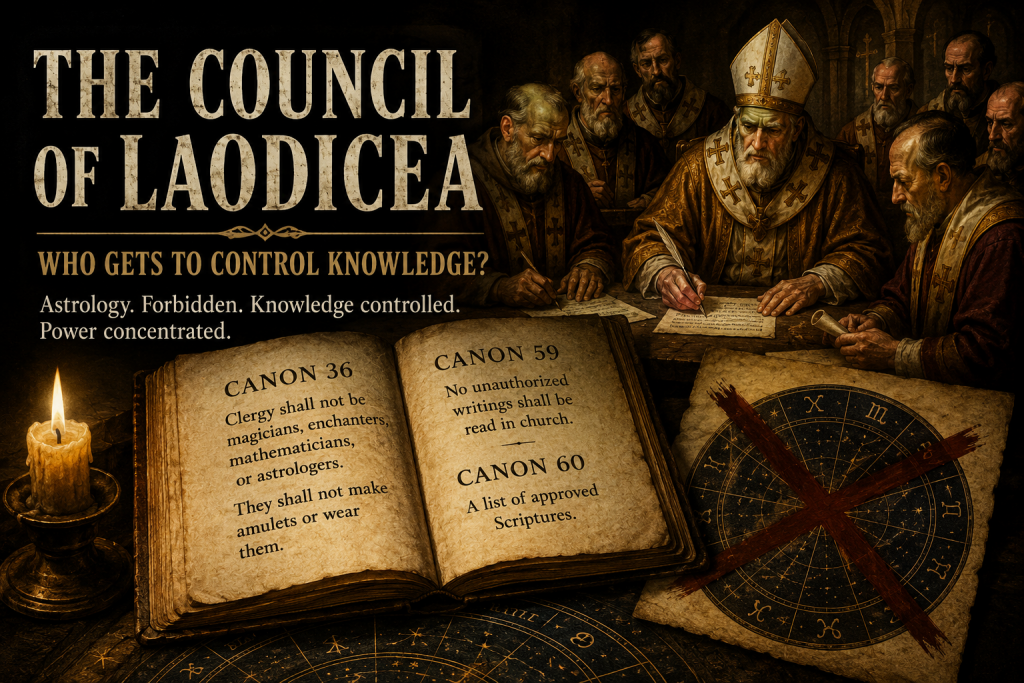
The Council of Laodicea: Who Gets to Control Knowledge?
Why is astrology condemned by the Christian faith, you ask?
Maybe the more interesting question is:
Who decided it should be—and why?
To explore that question, we have to go back roughly 1,660 years to the Council of Laodicea, a regional gathering of Christian bishops in Asia Minor, probably held sometime around A.D. 363–364.
This was a period when Christianity was undergoing an enormous transformation. What had once been a persecuted collection of communities was becoming increasingly organized, institutionalized and connected to political power.
And institutions do something almost instinctively as they grow:
They define the boundaries of acceptable knowledge.
When Spiritual Authority Becomes Institutional Authority
The Council of Laodicea produced dozens of rules governing Christian life.
They addressed worship, clergy, fasting, relationships with other religions, which religious writings could be publicly read, the invocation of angels, magic, amulets—and astrology.
These weren’t commandments delivered on stone tablets.
They were decisions made by human church authorities attempting to establish what Christianity would look like and what Christians would be permitted to practice.
That distinction fascinates me.
Because once you begin examining the history of religion, you repeatedly encounter the same question:
Where does spiritual guidance end and control of information begin?
Look Up—But Not Too Far
Canon 36 of Laodicea specifically prohibited clergy from practicing magic, enchantment and astrology and from making certain amulets.
Think about what astrology represented in the ancient world.
It wasn’t simply the little horoscope printed beside the crossword puzzle.
Astrology represented an entire system through which people attempted to understand themselves, predict events and interpret the universe around them.
Whether astrology actually works is a separate debate.
For the purpose of understanding history, consider something more provocative:
What if the people practicing these things genuinely believed they worked?
What if astrology, divination, mystical practices and other forbidden traditions represented competing ways of obtaining knowledge?
Then the question changes.
Instead of simply asking why the Church considered these practices wrong, we can also ask whether Church authorities considered them dangerous to their authority.
Because a person who believes he can communicate directly with the divine, interpret celestial signs, receive spiritual knowledge or explore hidden mysteries doesn’t necessarily need an institution standing between himself and the universe.
And institutions rarely surrender their position as gatekeeper voluntarily.
Control the Knowledge, Control the People
This is where Laodicea becomes especially interesting.
Canon 59 prohibited unauthorized writings from being publicly read in church.
A traditional Canon 60—although scholars dispute whether it was originally part of the council—provides a specific list of approved scriptural books.
Again, the important point isn’t the conspiracy theory that a handful of men secretly “created the Bible” one afternoon. That isn’t historically accurate. The biblical canon developed gradually over centuries through a complicated process involving many Christian communities.
But the larger pattern remains fascinating.
Some writings became authoritative.
Others didn’t.
Some spiritual practices became legitimate.
Others became forbidden.
Some methods of seeking knowledge became acceptable.
Others became heresy, superstition or magic.
And the institution increasingly positioned itself as the authority capable of telling ordinary people which was which.
That is power.
What Was Lost?
This is the question that interests me most.
Human beings had been watching the heavens for thousands of years before Christianity existed.
Ancient civilizations tracked planets, eclipses, solstices, equinoxes and constellations with astonishing precision. Astronomy, astrology, mathematics, religion and mythology were often intertwined rather than separated into the neat categories we recognize today.
People sought meaning through dreams.
They used herbs.
They practiced divination.
They carried protective objects.
They studied celestial cycles.
They preserved oral traditions and mystical teachings.
Then increasingly powerful religious institutions began deciding which forms of knowledge were acceptable.
Some undoubtedly disappeared because they were nonsense.
Some disappeared because cultures changed.
Some were absorbed into Christianity and given new names.
Some survived underground.
And perhaps some knowledge was genuinely lost.
We shouldn’t automatically assume everything forbidden by ancient religious authorities was secretly true.
But neither should we automatically assume everything they condemned was worthless.
Sometimes asking why something was forbidden is more revealing than simply accepting that it was.
The Gatekeepers
Imagine possessing knowledge that supposedly allows an individual to understand destiny, communicate with spiritual forces or interpret the universe without requiring a priest.
If you’re building an institution based partly upon being humanity’s intermediary with God, what do you do with that competing system?
Maybe you investigate it.
Maybe you absorb it.
Maybe you reinterpret it.
Or maybe you declare it forbidden.
That doesn’t prove astrology works.
It doesn’t prove magic works.
And it certainly doesn’t prove that the bishops at Laodicea gathered around a table plotting to hide supernatural powers from humanity.
History doesn’t give us evidence for that.
But it does give us evidence that religious authorities deliberately established boundaries around acceptable belief, acceptable writings and acceptable spiritual practices.
And once an institution controls those boundaries, it possesses extraordinary influence over how generations of people understand reality itself.
Forbidden Doesn’t Necessarily Mean False
That may be the most important lesson.
We’ve been conditioned to associate the word forbidden with dangerous, evil or false.
History gives us another possibility.
Sometimes something is forbidden because those holding authority believe it threatens the social order.
Sometimes because it contradicts established doctrine.
Sometimes because it competes with existing authority.
Sometimes because leaders genuinely believe they’re protecting people.
And sometimes power and sincere belief become so intertwined that separating one from the other becomes nearly impossible.
So when I discover that something was prohibited centuries ago, my first reaction isn’t necessarily to dismiss it.
My reaction is to become curious.
Who prohibited it?
What did they believe?
What authority did they possess?
What knowledge or practice were they attempting to suppress?
And who benefited from ordinary people no longer having access to it?
Those are questions worth asking—not only about Christianity, but about every institution that has ever claimed the authority to determine what human beings are permitted to know.
Perhaps some doors were closed because there was nothing behind them.
But perhaps we should occasionally open a few of those doors ourselves and look.
The more you know.
Knowledge is power. Educate yourself.