Don’t Meddle With the Fairies: A Buried-Alive Stunt and the Ancient Traditions Behind Ireland’s Fairy Forts
An old black-and-white Irish television clip stopped me in my tracks.
A man was being interviewed about digging a grave in a fairy fort. He was adamant that he would have nothing to do with it. However badly he needed money, disturbing that place was out of the question.
My first reaction was simple: Why would anyone put a grave in a fairy fort?
Was this an old burial ground? Some religious custom? Why deliberately disturb a place the surrounding community regarded with such fear?
The answer led to a remarkable publicity stunt—and a much older story about Ireland’s landscape, its supernatural inhabitants, and the boundaries people were careful never to cross.
Watch the original RTÉ report: “Buried Alive on a Fairy Fort.”
The man who wanted his grave dug before he was dead
The footage comes from RTÉ’s Newsbeat, broadcast on April 30, 1970, with reporter Cathal O’Shannon.
Cork stuntman Tim Hayes proposed spending eleven days buried alive in a coffin during a fête at Monamolin, County Wexford. The advertised location was a fairy fort. Hayes presented the undertaking as a challenge to fairy belief.
But someone had to dig the hole.
The report described local reluctance to disturb the site. Hayes suggested that workmates from Cobh dockyard might do the digging instead. What sounds, in a short social-media clip, like an argument over a funeral was actually a controversy surrounding an endurance performance. [1]
The publicity—and the burial—were real
A later investigation added a crucial twist.
Writing for RTÉ in January 2026, folklorist Michael Fortune described conversations with surviving organisers and participants. According to their recollections, the event was intended to raise money for Buffers Alley GAA, which needed a pitch and clubhouse.
Fortune reports that Hayes negotiated a £300 fee. The supposed fairy-fort burial helped attract attention, but the actual location was an ordinary corner of a field beside the road, now associated with the club’s grounds.
Hayes nevertheless underwent the burial: 239 hours, 31 minutes and 55 seconds, almost ten days.
Visitors paid sixpence to communicate with him through a telephone and pipe. Food was sent down using a child’s bucket. Participants recalled strengthening his coffin and digging the grave quietly at night.
Fortune also identifies the interviewee, Peter O’Brien, as a local actor and character whose dramatic contribution was fondly remembered.
These are later recollections, rather than a contemporaneous confession. They support the publicity explanation without establishing exactly what everyone involved privately believed. [2]
The distinction matters: a staged controversy can succeed only if its audience recognises something meaningful in it. Hayes and the organisers were drawing upon traditions with roots far deeper than their fundraising scheme.
What is a fairy fort?
In Ireland, a “fairy fort” commonly means an ancient ringfort that acquired supernatural associations.
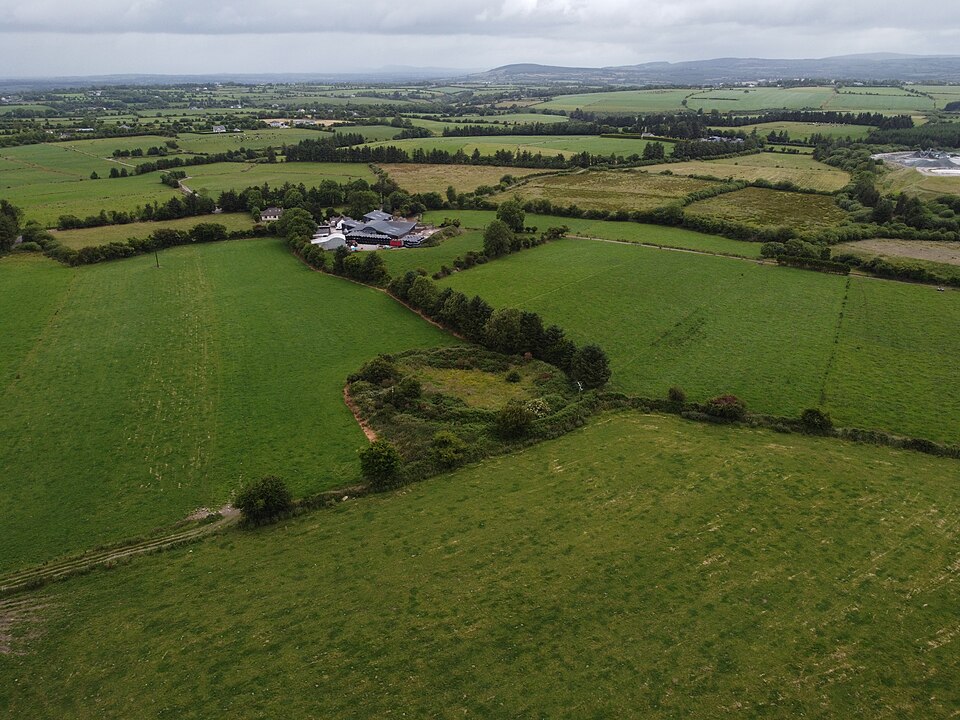
A ringfort is typically a roughly circular enclosure surrounded by an earthen bank and ditch, or sometimes stone walls. Despite the military impression created by “fort,” many were farming homesteads rather than castles or battle positions.
The Heritage Council describes these as characteristic early medieval settlements. Its account of Rathbeagh, County Kilkenny, identifies a farming enclosure that has stood for more than a thousand years. [3]
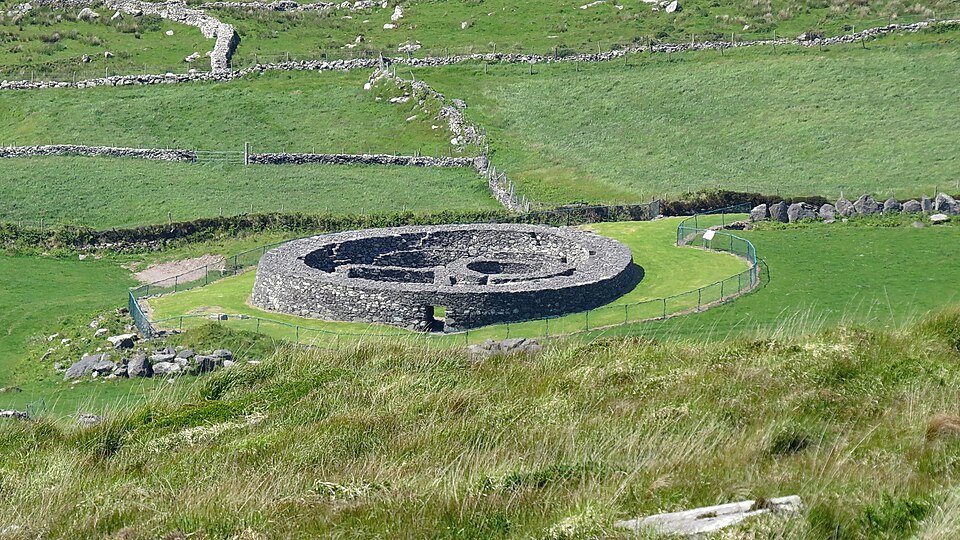
At Loher Ringfort in County Kerry, the surviving interior includes two stone houses, one circular and one rectangular. The circular house also contains an entrance to a souterrain, an underground passage or chamber. This is tangible evidence of habitation beneath the folklore. [4]
The physical remains and their later interpretation are separate questions. People built the enclosure; subsequent communities could understand it as belonging to supernatural neighbours.
Nor should every ancient mound be called a ringfort. A prehistoric burial mound and an early medieval farmstead are different archaeological monuments, even when both attract stories about the Otherworld.
Who were the inhabitants?
The English word fairy can obscure the Irish tradition it is being used to describe.
Irish terminology includes sí, with sídhe familiar from older spellings, and expressions referring to the people associated with those places. The Irish dictionary Foclóir Gaeilge–Béarla gives sí the meaning “fairy mound,” alongside expressions concerning fairy inhabitants. The word connects supernatural beings with particular features of the landscape. [5]
These inhabitants were not necessarily harmless miniature people.
In his 1888 collection, Fairy and Folk Tales of the Irish Peasantry, W. B. Yeats presents beings who could reward kindness, respond dangerously to offence, and accept small offerings such as milk. His collection also includes the disturbing changeling tradition: a human, particularly a child, might supposedly be taken away and a substitute left behind.
Such accounts belong to the history of belief. They do not establish that supernatural abductions occurred. They reveal how frightening and intimate fairy explanations could become when applied to families, illness and misfortune. [6]
Calling these beings “the good people” was therefore more complicated than describing their temperament. Courtesy could be a precaution.
How old is the fairy tradition?
There is no single date when someone invented fairies.
We need to distinguish the age of a monument, the earliest surviving record of a belief, and the age of the English word used to describe it.
Archaeologist Marion Dowd identifies documentary references to the Irish sí as early as the seventh century AD, noting that the terminology was already archaic then.
That places an identifiable written strand of the tradition roughly fourteen centuries in the past. It also suggests an earlier history, but does not provide a precise beginning.
An ancient mound cannot, by itself, prove that its original builders held the fairy beliefs recorded centuries later. The age of the earthwork is not automatically the age of every story attached to it. [7]
The responsible answer is that Irish fairy tradition has deep medieval documentation and likely older elements, while its earliest development remains beyond precise dating.
Were fairies once Ireland’s gods?
A familiar explanation connects the fairies with the Tuatha Dé Danann, the supernatural people of Irish mythology.
Medieval literature certainly offers important connections between supernatural figures and the mound-associated Otherworld. In The Wooing of Étaín, preserved and translated through University College Cork’s CELT project, Midir and Óengus belong to a world of extraordinary powers, transformation and relationships crossing the boundary between human and supernatural society.
This is a richly developed literary world, with supernatural figures who possess identities, households and complicated relationships. [8]
But “fairies are simply the old gods” is too tidy.
Dowd notes similarities between the sí and the Tuatha Dé Danann while observing that ordinary oral tradition rarely, if ever, explicitly makes that connection. Literary mythology and locally transmitted belief overlap without being identical. [7]
Fairy tradition is better approached as something that accumulated explanations, rather than a single doctrine passed down unchanged.
Where Christianity enters the story
Christianity supplied another explanation.
Yeats records the idea that fairies were fallen angels occupying an uncertain position between salvation and damnation. This placed them inside a Christian understanding of the universe while allowing them to remain distinct from ordinary humans.
His presentation also includes competing interpretations involving older gods. Even within one collection, the answers do not settle into a single system. [6]
That helps explain the apparent contradiction in someone invoking God while fearing an enchanted field.
A person could follow Christianity and still consider certain places dangerous to disturb. From that perspective, prayer and caution addressed different parts of the same uncertain world.
The word “fairy” originally described a realm
The English word has its own history.
The Online Etymology Dictionary traces fairy to forms appearing around 1300, derived from Old French faerie. Early meanings included the land of the fays, enchantment and magic. By the late fourteenth century, the word could refer to an inhabitant of that supernatural realm.
The related French fae, later fée, is commonly traced through Medieval Latin to Latin Fata, the Fates. The dictionary also notes an alternative proposal involving the Roman oracular figure Fatuus/Faunus, so the deepest derivation should not be presented as entirely uncontested.
The familiar spelling faerie is an older form, not evidence of a separately established species of supernatural being.
Why people left the forts alone
Most revealingly, the English word once pointed toward an enchanted condition or country before becoming the usual name for its inhabitants. [9]
The prohibition was broader than digging a grave.
RTÉ’s discussion of fairy-fort traditions describes restrictions on ploughing, planting and disturbing places understood to belong to the fairies. Houses could also be positioned to avoid supernatural routes or gathering places.
The underlying idea was that humans shared the landscape with another population whose property and movements deserved respect.
That could make an apparently neglected patch of ground something quite different: a place deliberately spared because interference might threaten a household’s health, animals or fortune. [10]
We do not have to rely entirely on modern retellings. Ireland’s Schools’ Collection preserves local accounts gathered by schoolchildren from their communities, predominantly in 1937–1938, with some collecting continuing into 1939.
The project drew contributions from approximately five thousand schools. It offers an extraordinary record of what people actually told one another about their surroundings. [11]
Two warnings preserved in the folklore archive
A contribution from Broca, County Leitrim, recounts a story about Bernard McManus cutting firewood from a fairy fort near Glenfarne.
His companion, Tom McDermott, warned him against doing so. Bernard refused to be deterred.
The opening of the account is valuable even before the story reaches its consequences: a named individual, a recognisable location, a practical need for timber, and a warning about crossing an established boundary. [12]
Another account, from Kilcleagh, County Westmeath, describes a circular, earth-banked fort at Boyanna. Its owner supposedly killed a badger there and found his sow dead the following morning.
The account also warns that cutting bushes inside the enclosure would result in a death. [13]
These are records of stories, not verified demonstrations of supernatural punishment. Their historical importance lies in what they reveal about community expectations: disturb the place, and subsequent misfortune may be understood as a consequence.
Food, iron and the risks of visiting the Otherworld
W. Y. Evans-Wentz’s The Fairy-Faith in Celtic Countries, published in 1911, records a broader network of supernatural precautions.
Among them are warnings about eating Otherworld food, beliefs in iron or steel as protection, and accounts linking interference with fairy places to illness.
One recorded story makes an ordinary needle appear to fairies as an immense iron barrier protecting a child. The everyday object becomes powerful precisely because it separates the human household from supernatural intrusion.
Evans-Wentz’s work is useful as a historical collection of testimony and interpretation. His own explanations should be read critically; collecting an account does not confirm its supernatural cause. [14]
Together, these traditions describe a world with rules of hospitality, ownership and danger. The Otherworld was fascinating, but entering into relations with it could carry obligations or risks.
How the frightening neighbours became decorative fairies
The fairies familiar from modern illustration are one development within a much larger history.
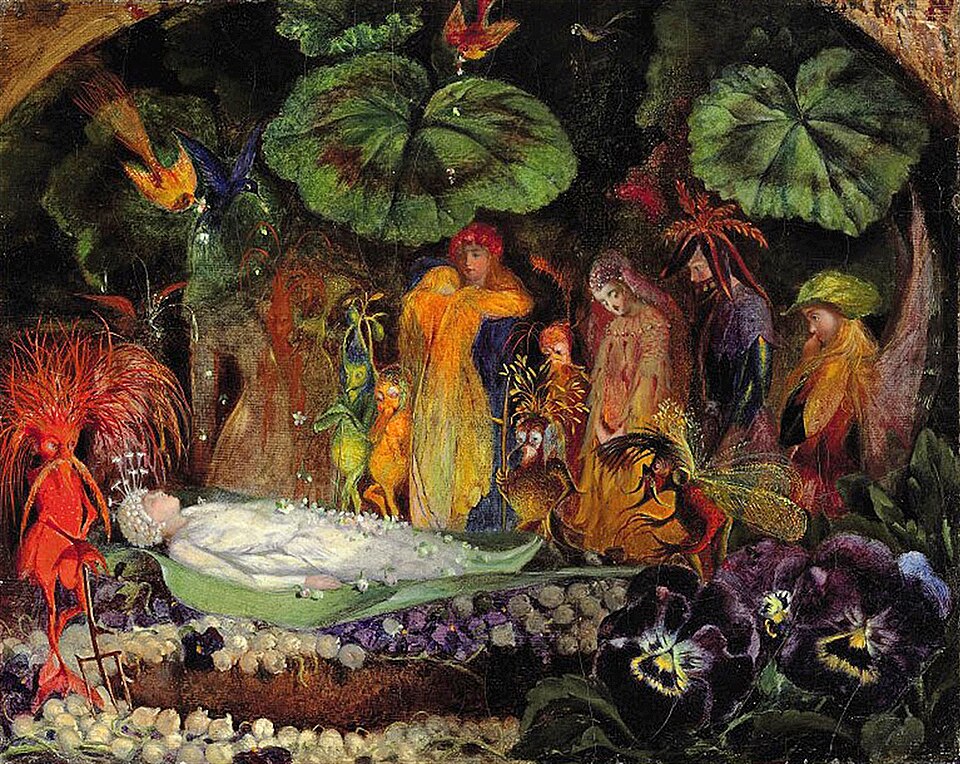
The Frick Collection’s account of Victorian fairy painting explains how nineteenth-century artists drew on Shakespeare, Walter Scott, theatre, dance and music. Fairy imagery became a commercially successful artistic genre.
That helps explain why later audiences often encounter fairies through elaborate painted scenes and literary fantasy, rather than through warnings about a particular field or household.
It would be misleading to say that Victorian artists invented fairy imagery. Their importance lies in helping shape and circulate influential visual interpretations. [15]
The man refusing to dig at Monamolin belongs to another setting entirely: a landscape where fairy stories could still give a patch of ground practical authority.
A fairy bush and a modern road
The influence did not end with black-and-white television.
In 1999, storyteller Eddie Lenihan campaigned to save a lone fairy bush at Latoon, County Clare, threatened by road construction. The bush was preserved within the road scheme.
RTÉ’s documentary Eddie and the Lone Bush explores that campaign. Whatever an individual’s beliefs, the episode demonstrates that folklore could still influence a modern debate over a specific place. [16]
There was also a practical historical benefit to leaving enchanted places untouched. As RTÉ’s account observes, traditions of avoiding fairy property helped preserve archaeological remains that might otherwise have been cleared or altered. [10]
What the buried-alive story leaves us with
The question that started this investigation has a straightforward answer: the grave was intended for a living performer, and the fairy-fort controversy was, according to later participant recollections, part of the publicity surrounding a fundraiser.
Yet that explanation does not empty the footage of meaning.
The stunt worked because “don’t meddle with that place” was already a powerful message. A television audience could recognise the argument without needing its entire history explained.
Behind the spectacle stood older ways of understanding land, ruins, illness, hospitality and unseen neighbours. Behind those stood medieval texts, changing religious interpretations, and generations of local storytelling.
The publicity belongs to 1970. The tradition it drew upon reaches much further back.
And what began as a baffling clip about digging a grave turns out to be a revealing encounter between folklore, performance and the enduring power of a place.
Sources and further reading
- RTÉ Archives — “Buried Alive on a Fairy Fort.” Original Newsbeat report, broadcast April 30, 1970.
- Michael Fortune — “The Cork stuntman who wanted to be buried in a fairy fort.” RTÉ Culture, January 3, 2026; later participant recollections.
- The Heritage Council — “Rathbeagh Ringfort, Co Kilkenny.” Archaeological background.
- Heritage Ireland — “Loher Ringfort.” Surviving houses and souterrain.
- Teanglann — “Sí,” in Foclóir Gaeilge–Béarla. Irish terminology.
- W. B. Yeats — Fairy and Folk Tales of the Irish Peasantry. First published in 1888; historical folklore collection.
- Marion Dowd — “Bewitched by an Elf Dart: Fairy Archaeology, Folk Magic and Traditional Medicine in Ireland.” Cambridge Archaeological Journal 28(3), 2018, pages 451–473.
- University College Cork, CELT — The Wooing of Étaín. Translated medieval Irish narrative.
- Online Etymology Dictionary — “Fairy.” Word origins and changing meanings.
- Marion McGarry — “The superstitions and mysteries around Ireland’s ‘fairy forts.’” RTÉ Brainstorm.
- Dúchas — “The NFC Collections.” Background to the Schools’ Collection.
- Dúchas — “Fairy Forts,” Broca. Local account from County Leitrim.
- Dúchas — “Fairy Forts,” Kilcleagh (Mixed). Local account from County Westmeath.
- W. Y. Evans-Wentz — The Fairy-Faith in Celtic Countries. Published in 1911; historical testimony and interpretation.
- The Frick Collection — “Victorian Fairy Painting.” Artistic and literary influences.
- RTÉ Documentary on One — “Eddie and the Lone Bush.” Documentary about the Latoon preservation campaign.