Beyond the First-Aid Kit: Medical and Pet Supplies for a Prolonged Grid Failure
Practical supplies, veterinary–human crossover products, and emerging research for disruptions lasting more than 30 days.
Research reviewed November 15, 2026.
A month into a major disaster, medical preparedness becomes more complicated than having a few bandages. Pharmacies may be closed, transportation disrupted, communications unreliable, and professional care difficult to reach. A damaged paw, broken tooth, persistent skin problem, or contaminated wound can become a serious obstacle.
This guide looks beyond food and drinking-water storage. It covers prolonged care for people and pets, practical equipment, genuine overlap between human and veterinary products, and the evidence behind options frequently discussed for last-resort situations.
Tractor Supply and similar farm stores are useful starting points, supplemented by pharmacies and medical-supply retailers. Product examples identify categories; availability and formulations vary.
The purpose is to distinguish established uses, plausible crossover, and experimental findings. Veterinary medicines are included explicitly. Cancer treatments will be addressed separately.
1. Master Supply List
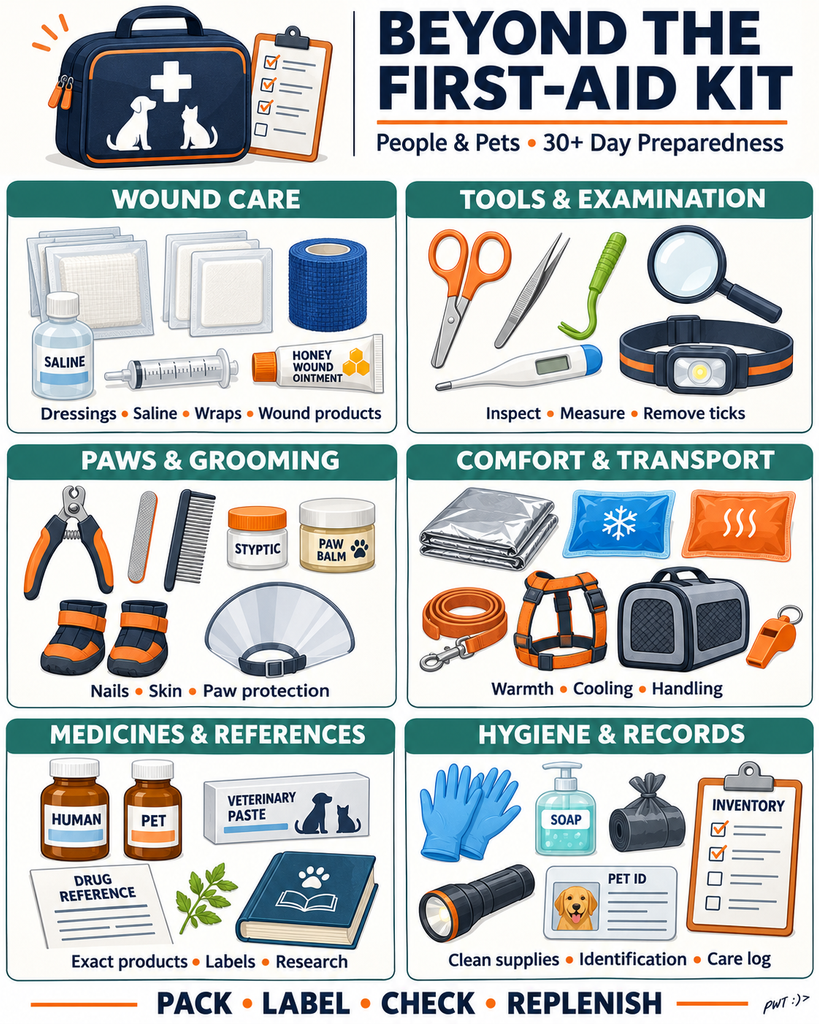
Plan for repeated care, not just a single injury. Keep a portable kit for immediate use and replacement supplies for a prolonged disruption.
Dressings, Bandages, and Bleeding-Control Supplies
- Sterile gauze pads in several sizes, including 2 × 2 and 4 × 4 inches.
- Nonstick wound-contact pads.
- Absorbent dressings and rolled gauze.
- Plain cohesive bandage wrap, such as Vetrap or SyrFlex.
- Medical tape and gentle paper tape.
- Adhesive bandages in assorted sizes.
- Butterfly bandages or wound-closure strips for suitable minor human cuts—not dirty punctures or animal bites.
- Triangular bandages and safety pins.
- Blister dressings and protective padding.
- Pet-labeled styptic powder or pencil for minor superficial bleeding, particularly nail-trimming nicks. Keep this distinct from supplies intended for major bleeding.
Cleaning, Irrigation, and Wound Products
- Plain sterile saline wound wash.
- Sterile saline specifically labeled for eye irrigation.
- Needleless irrigation syringes in useful sizes.
- Eyedropper or bulb syringe.
- Mild soap and cleansing wipes appropriate to their intended use.
- Alcohol prep pads for their labeled uses, rather than routine irrigation of open wounds.
- Human-labeled hypochlorous-acid wound cleanser, such as an appropriate Puracyn product.
- Pet-labeled wound cleanser, such as an appropriate Vetericyn product.
- Silver Honey pet wound product, with its original instructions.
- Human-labeled sterile medical-honey dressings, with recall status checked.
- Povidone-iodine or chlorhexidine products where appropriate, retaining exact formulation and dilution instructions.
- Plain petroleum jelly for suitable minor human wounds and skin protection.
- Cotton-tipped applicators for appropriate external applications—not probing wounds or ear canals.
- Clean washcloths, full-size towels, and compressed towels.
Examination Tools and Small Equipment
- Blunt-ended bandage scissors.
- Fine-tipped tweezers for ticks and superficial splinters.
- Dedicated tick-removal tool.
- Packaged superficial splinter-removal tools.
- Magnifying glass.
- Small inspection flashlight and hands-free headlamp.
- Spare batteries or a suitable charging arrangement.
- Digital human thermometer.
- Separately labeled pet thermometer and suitable lubricant.
- Tongue depressors.
- Small mirror.
- Cleanable tray or work surface.
- Small sealable bags for keeping items organized.
Grooming, Nails, Paws, and Skin
- Pet nail clippers and nail file.
- Fine-tooth flea comb.
- Grooming comb, brush, or grooming glove.
- Pet-specific paw protectant or balm.
- Disposable or washable paw booties in the correct size.
- Recovery cone or appropriately fitted recovery collar that prevents access to the affected area.
- Species-appropriate flea and tick prevention.
- Human-labeled skin protectants and antifungal products for their intended uses.
- Sting-relief wipes or products with ingredients and species suitability clearly identified.
- Spare socks, protective footwear, and padding for human foot care.
Handling, Restraint, and Transport
- Spare leash and emergency slip lead.
- Properly fitted collar or harness with identification.
- Suitable pet carrier or crate.
- Appropriately fitted muzzle for necessary handling—not during vomiting, overheating, or breathing difficulty.
- Large towel or blanket for handling and transport.
- Properly fitted support sling when needed for an animal with mobility limitations.
- Basic splinting and padding materials, with instructions for their use.
- Reflective bandana, collar attachment, or other visibility aid.
- Whistle.
- Collapsible bowl.
- Familiar comfort item for the pet.
Temperature and Comfort Supplies
- Emergency thermal blanket.
- Ordinary blankets and washable bedding.
- Instant cold packs that do not require a freezer.
- Heat packs suitable for the intended use.
- Cloth covers or barriers for hot and cold packs.
- Pressure-relieving padding for limited mobility.
Keep chemical packs out of pets’ reach and follow their instructions. Excessive or direct heat and cold can injure skin.
Dental Supplies
- Human toothbrushes and fluoride toothpaste.
- Pet toothbrush and pet toothpaste.
- Dental floss.
- Small dental inspection mirror.
- Commercial temporary filling or crown-repair material with original instructions.
- Orthodontic wax where relevant.
Hygiene, Sanitation, and Waste
- Disposable nitrile examination gloves in suitable sizes.
- Soap and hand sanitizer.
- Paper towels and washable cleaning cloths.
- Labeled surface disinfectant with dilution and contact-time instructions.
- Heavy-duty waste bags and pet-waste bags.
- Absorbent pads and protective bedding covers.
- Separate containers for clean supplies, used equipment, and waste.
- Laundry supplies.
- Pet-appropriate cleaning or grooming wipes.
- A workable emergency toilet arrangement.
Medicines and Product Records
- Regular human prescriptions and written instructions.
- Regular pet prescriptions and written instructions.
- Appropriate human over-the-counter medicines for established household needs.
- Pet medicines selected for the particular animal and condition.
- Original packaging, package inserts, lot numbers, and expiration dates.
- Accurately marked oral measuring syringes where required.
- A product-specific storage plan for refrigerated medicines.
- Separate, clearly labeled storage for human and animal medicines.
Identification, References, and Organization
- Recent photographs of each pet, including identifying markings.
- Microchip numbers and registration details.
- Vaccination and veterinary records.
- Human and pet medication and allergy lists.
- Printed human and pet first-aid guides.
- Veterinarian, emergency hospital, pharmacy, and alternate-care contacts.
- Printed addresses and travel routes.
- Notebook, pens, permanent marker, and adhesive labels.
- Care log for symptoms, temperatures, treatments, and response.
- Inventory sheet showing quantities, expiration dates, and replenishment needs.
- A visible “last checked” date.
- Portable organizer, water-resistant document pouches, and a larger replacement-supply container.
2. How Much Is Enough for 30 Days?
Calculate supplies by care events. One persistent wound may consume more materials than several uninjured people.
The example below assumes one dressing change daily for 30 days. It is an inventory calculation, not a treatment schedule. Actual frequency depends on the wound, drainage, contamination, and dressing instructions.
| Assumed use per change | 30-day baseline | With a 50% reserve |
|---|---|---|
| One nonstick pad | 30 pads | 45 pads |
| Two gauze pads | 60 pads | 90 pads |
| One pair of gloves | 60 individual gloves | 90 individual gloves |
| One waste bag | 30 bags | 45 bags |
The reserve is a planning allowance. Wet dressings, additional glove changes, other injuries, and pet care increase consumption. Estimate tape and wrap using the actual dressing arrangement. Irrigation needs vary too much for one universal volume.
3. Wound Products and Genuine Human–Animal Crossover
A plain bandage, veterinary antiseptic concentrate, and animal antibiotic are different categories. Evaluate the exact product rather than treating everything in the animal aisle as equivalent.
| Product | Practical use | Crossover details |
|---|---|---|
| Plain sterile 0.9% saline | Flushing debris from wounds. | Useful for people and animals. Eye irrigation requires a suitable eye product. Contact-lens disinfectant is not plain saline. |
| Sterile gauze and nonstick pads | Covering wounds, absorbing drainage, and applying pressure. | Clear crossover. Preserve package integrity and the cleanliness of the wound-contact surface. |
| Plain cohesive wrap | Securing dressings. | Useful as an outer wrap for either. Usually not a sterile wound-contact layer; tight application can restrict circulation. |
| Vetericyn and Puracyn | Hypochlorous-acid wound care. | Innovacyn makes animal and human lines using related technology. Vetericyn is the animal line; Puracyn is the human line. Household bleach is not equivalent. |
| Silver Honey | Veterinary wound and skin care using Manuka honey and MicroSilver BG. | Honey and silver also have human wound-care applications. This does not establish human-use equivalence of the finished veterinary mixture. |
| Human medical-honey dressings | Management of selected wounds. | A direct human option. Sterile medical honey differs from pantry honey and does not control heavy bleeding. |
| Povidone-iodine | Antisepsis in human and veterinary care. | Solutions, detergent scrubs, and other iodine preparations differ. Surgical scrub is not interchangeable with wound-irrigation fluid. |
| Chlorhexidine | Skin antisepsis and selected veterinary applications. | Concentrates, skin washes, and oral products differ. Strong solutions can damage healing tissue. Skin formulations must be kept out of eyes and ears. |
| Plain petroleum jelly | Skin protection and moist healing of minor human cuts. | A useful human-kit product. Medicated farm salves are not automatically equivalent. Animal use depends on the site and licking. |
| Styptic products | Minor superficial bleeding, including nail-trimming nicks. | Human and animal products exist, but ingredients and labels vary. These are not substitutes for major-bleeding supplies. |
Veterinary wound guidance distinguishes suitable irrigation fluids from detergent scrubs and stronger antiseptics that can damage tissue. Hydrogen peroxide and alcohol are not routine open-wound irrigation fluids.
Certain MediHoney and CVS wound products have been recalled for packaging or sterility problems. Check the exact product against the FDA notice in the sources.
4. Sanitation and Storage Are Part of Medical Care
Store medical supplies away from feed, pesticides, fuels, dust, moisture, and temperature extremes. Keep sterile items sealed until needed.
A kennel or barn disinfectant is not automatically a skin antiseptic. Follow the exact surface-product directions for dilution and contact time, and never mix cleaning chemicals.
Cleaning removes material; disinfection reduces many microorganisms; sterilization requires a validated process. Wiping a tool with alcohol does not make it a sterile surgical instrument.
Medicine storage life varies among tablets, dry powders, mixed liquids, eye products, and refrigerated drugs. An unopened powder’s expiration date does not establish how long it lasts after mixing. Record opening or mixing dates where relevant.
Dogs and cats share many dressing supplies, but not all medicines or parasite products. Human pain medicines and combination cold products are not automatically suitable for either.
5. Veterinary Medicines and Human Crossover
Many active ingredients are used in both human and veterinary medicine. Others have no established human use. The useful questions concern the exact drug, formulation, manufacturing quality, route, and intended treatment.
The following describes pharmacological overlap. It is not a diagnosis-to-drug selection chart or a guide to converting animal products into human doses.
| Drug or category | Human relevance | Animal-product distinction |
|---|---|---|
| Amoxicillin; fish-marketed products such as Fish Mox | A penicillin-class antibiotic for susceptible bacterial infections. | Selected fish capsules have undergone laboratory testing. Those results do not verify every seller or batch, or identify an appropriate treatment for an unknown infection. |
| Fish erythromycin | Erythromycin is a human macrolide antibiotic. | Human products have different formulations and release characteristics. Aquarium products may be intended for tank-water treatment. The fish-antibiotic study below did not test erythromycin. |
| Cephalexin; fish-marketed products such as Fish Flex | A cephalosporin antibiotic for susceptible bacterial infections. | Selected fish products were included in the laboratory comparison below. This does not establish equivalence across suppliers. |
| Doxycycline | A human antibiotic with additional condition-specific anti-inflammatory applications. | Veterinary use is documented, but compounded liquids and other formulations require individual assessment. A rosacea formulation differs from an infection-treatment regimen. |
| Penicillin products | Several penicillin medicines have established human uses. | Penicillin V, penicillin G salts, depot suspensions, and combination products are not interchangeable. A livestock injection is not an oral substitute. |
| Oxytetracycline and other tetracyclines | This family has human medical uses; oxytetracycline also has a history of human use. | Long-acting livestock injections are not equivalent to oral human doxycycline or tetracycline. Shared family membership does not establish matching delivery. |
| Metronidazole | Active against selected anaerobic bacteria and protozoa. | Also used in veterinary practice, sometimes through human medicines prescribed for animals. It is not a general treatment for every episode of diarrhea or infection. |
| Ivermectin | Established antiparasitic uses and specific topical applications. | Human tablets and creams differ from horse paste, pour-ons, injections, and combination dewormers. Some animal products contain additional active drugs. |
| Fenbendazole; Panacur and certain Safe-Guard products | No approved human indication or established human treatment regimen. | A veterinary antiparasitic for specified animals and parasites. Its relationship to albendazole and mebendazole does not make them interchangeable. |
| Topical antifungals such as miconazole or clotrimazole | Human topical products treat selected fungal infections. | Animal sprays, shampoos, and ear products may contain additional antibiotics, steroids, or solvents. A combination ear product is not equivalent to a plain skin cream. |
Not every livestock antibiotic has a reasonable human counterpart. Tylosin and tilmicosin should not be treated as interchangeable with erythromycin because they belong to a related class. Accidental human injection of tilmicosin can be fatal.
When a veterinarian prescribes a licensed human medicine for an animal, the product may literally be a human formulation. That establishes its identity, not that the animal’s treatment instructions apply to a person.
6. Fish Antibiotics: What Has Actually Been Tested?
A 2022 laboratory study compared selected fish-marketed amoxicillin and cephalexin capsules with human prescription products. Tested samples met the study’s drug-content standards. No major impurities were identified, although some additional ingredients were unidentified.
This supports a limited but meaningful finding: some sampled fish products contained the stated antibiotics at the measured levels. It does not establish equivalence for every brand, later batch, or storage condition. Erythromycin was not tested, and the study did not demonstrate treatment outcomes in people.
What matching chemical names and milligrams leave unanswered
- Identity: Does the product contain the stated drug?
- Strength: Is the measured amount consistent with the label?
- Formulation: Is it an oral dosage form, a tank-water preparation, or a combination?
- Quality: Are contaminants, manufacturing, and packaging controlled?
- Storage: Has heat, moisture, or time altered it?
- Clinical fit: Is the drug appropriate for the infection and person?
If products truly have equivalent ingredients, formulation, quality, and delivery, an animal label does not change the molecule. The practical difficulty is verifying those conditions from packaging, pill appearance, or an imprint alone.
FDA identifies unapproved ornamental-fish antibiotics as products whose safety, effectiveness, and manufacturing quality have not undergone its review. Enforcement actions have included products containing amoxicillin, penicillin, tetracycline, and erythromycin.
A prolonged collapse changes available choices. It does not make an antibiotic effective against an organism it does not cover, or eliminate the need to drain some infections or remove damaged tissue. Advance planning offers the opportunity to arrange appropriate human prescriptions and written instructions before access disappears.
7. Ivermectin: Established Uses and Research Beyond Parasites
Established human applications
Oral ivermectin has approved human uses for strongyloidiasis and onchocerciasis. Human topical formulations have uses including head lice and inflammatory lesions of rosacea.
Oral ivermectin is also used off-label for scabies. CDC discusses it as a treatment option while identifying populations in which safety has not been established.
These are specific applications. They do not establish ivermectin as a general antibiotic, antiviral, or treatment for unexplained whole-body inflammation.
Antibacterial findings: laboratory evidence
A 2024 study examined ivermectin and moxidectin against 59 bacterial isolates. Researchers found effects on bacterial growth resembling some antibiotic effects. Repeated exposure also produced reduced sensitivity to the antiparasitic drugs and, in some cases, antibiotics.
The study establishes biological activity under laboratory conditions. It did not establish a human antibacterial regimen or demonstrate successful treatment of bacterial infections in people.
2024 study: bacterial growth inhibition and adaptation.
Inflammation and bacterial clearance
A recent cell-and-mouse study examined ivermectin in experimental Pseudomonas aeruginosa pneumonia. It found changes in inflammatory signaling and bacterial clearance, but the effects differed by model.
In cultured macrophages, ivermectin impaired bacterial clearance. In mice—particularly mice lacking a specific immune receptor—it improved some bacterial and inflammatory outcomes. This shows context-dependent immune effects, not a universal ability to kill bacteria or improve infections.
Study: ivermectin, macrophage activity, and experimental Pseudomonas pneumonia.
Rosacea: demonstrated human benefit
Topical ivermectin has clinical-trial evidence for reducing inflammatory rosacea lesions and is an approved human treatment for that condition.
A 2025 study examined skin mites, bacteria, and host gene activity during topical treatment. Improvement was associated with reduced mite density and changes in host gene activity, rather than normalization of the bacterial microbiome.
This supports a specific skin application. It does not establish that taking oral ivermectin reduces inflammation throughout the body.
Human ivermectin cream prescribing information and trials.
2025 study: microbe–host interactions in rosacea.
Antiviral research: signals and clinical outcomes
Ivermectin has shown antiviral effects in experimental systems. The clinical question is whether a useful effect occurs at achievable exposure in people and improves recovery, function, or survival.
- Dengue, 2021: A randomized trial involving 203 participants found faster clearance of the viral NS1 antigen. It did not demonstrate clinical efficacy or faster clearance of circulating virus. Study.
- COVID-19, ACTIV-6: A large randomized placebo-controlled trial found that a higher-dose, longer ivermectin course did not improve sustained recovery. A later correction included participants mistakenly excluded from the original analysis; the conclusion remained negative. Corrected trial.
- A small positive study published in 2026: A trial of 126 initially asymptomatic participants reported a greater change in PCR cycle-threshold values after ivermectin, suggesting reduced viral RNA. Clinical outcomes were less certain. The study was conducted in 2021, despite its 2026 publication date. It does not outweigh larger trials showing no clinical benefit, and PCR values do not directly measure infectiousness. Study.
- Hospitalized COVID-19, published in 2026: A small REMAP-CAP randomized comparison found ivermectin unlikely to improve its main combined outcome involving organ-support-free days and hospital survival. Its limited sample leaves substantial uncertainty about effect size. Study.
Why concentration matters
A 2020 pharmacokinetic analysis compared early laboratory SARS-CoV-2 findings with predicted human exposure. The laboratory concentration required for substantial inhibition was far above blood concentrations reached with approved oral dosing. Modeling did not establish an achievable treatment exposure even with much higher simulated doses.
This was a model with assumptions, not a clinical trial. Its practical lesson is that activity in a dish cannot be converted into a human treatment by simply increasing the amount taken.
For the bacterial and mouse studies discussed here, an effective and safe human antibacterial or systemic anti-inflammatory exposure has not been established.
Pharmacokinetic analysis of ivermectin exposure and laboratory antiviral concentrations.
Where ivermectin fits
Ivermectin belongs in this discussion because it is an established human antiparasitic with additional topical uses and active research beyond parasites. The evidence does not establish it as a substitute for antibiotics or as a general antiviral stockpile medicine.
Horse paste, pour-ons, veterinary injections, and human tablets have different formulations. Some dewormers contain additional drugs. Their routes and concentrations cannot be exchanged merely because ivermectin appears on the label.
8. Other Drugs With Effects Beyond Their Familiar Use
Doxycycline provides an example of genuine repurposing. A specific human formulation is approved for inflammatory rosacea lesions, with instructions distinguishing it from products used to treat bacterial infections.
This demonstrates that a drug can have useful effects beyond its best-known role. It also shows why the indication and formulation matter: the rosacea product is not intended to treat infections, and a veterinary formulation does not automatically reproduce that treatment.
FDA prescribing information for ORACEA.
Fenbendazole remains relevant as a veterinary dewormer, but no established human regimen follows from its relationship to other antiparasitic drugs. Cancer-related claims will be examined in the separate follow-up.
9. Five Practical Scenarios
A minor cut during debris cleanup
Useful supplies: gloves, clean irrigation fluid, a nonstick dressing, and tape.
Clean loose contamination, control bleeding with direct pressure, and protect the area. Do not probe deeply embedded material or seal a dirty puncture with household glue. Increasing pain, spreading redness, drainage, or fever warrants reassessment. Tetanus vaccination status matters for dirty wounds.
A blister makes walking difficult
Useful supplies: padding, an appropriate blister dressing, dry socks, and suitable footwear.
Reduce pressure and rubbing. Protect an intact blister rather than routinely opening it. If it opens, treat the exposed surface as a minor wound. Spreading redness or inability to bear weight changes the situation.
A dog injures a paw and keeps licking it
Useful supplies: saline, nonstick pads, a recovery cone, and handling equipment.
Gently inspect and rinse a minor surface injury when safe. Prevent licking. Paw bandages can trap moisture or become too tight. Deep punctures, embedded objects, severe bleeding, or inability to bear weight exceed simple surface care.
A filling comes out
Useful supplies: a mirror, floss, and a commercial temporary dental-repair kit.
Keep the area clean and use repair material only for its intended situation. Temporary material protects; it does not determine the cause of pain or treat an abscess. Facial or neck swelling, difficulty swallowing, or difficulty breathing changes the urgency.
A wound contacts floodwater
Useful supplies: clean water or appropriate saline, a clean dressing, and a symptom log.
Clean promptly and prevent further exposure. Coastal water can expose wounds to organisms such as Vibrio. Rapidly increasing pain, swelling, discoloration, blistering, or systemic illness requires urgent assistance. An arbitrary antibiotic is not reliable coverage for every water-associated infection.
10. What Common Supplies Cannot Do
- A cleanser cannot reliably remove deeply embedded material or dead tissue.
- An ointment cannot replace control of major bleeding.
- An antibiotic cannot repair a tooth, set a fracture, or substitute for every necessary drainage procedure.
- A bandage cannot establish that the injury underneath is healing.
- A familiar drug name cannot verify product quality or identify the infection.
Uncontrolled bleeding, rapidly worsening pain or swelling, confusion, breathing difficulties, or exposed deep structures require whatever emergency assistance or evacuation remains available.
11. Herbal Approaches and Homeopathy
Herbal products
Plants can contain pharmacologically active substances. Evidence depends on the plant, preparation, concentration, condition, and route.
- Aloe gel: Clinical research suggests some topical preparations may help burn healing and pain. This does not establish fresh plant material as a sterile dressing or justify use on serious burns. Oral aloe products are different preparations.
- Tea tree oil: Limited evidence suggests possible benefit for acne and athlete’s foot, with uncertain effectiveness for many other claims. It can irritate skin and must not be swallowed. Concentrated tea tree oil can poison dogs and cats.
- Honey: Medical-grade honey has wound-care applications. Kitchen honey and homemade herbal mixtures do not meet the same preparation and sterility standards.
Herbal products are not automatically substitutes for systemic antibiotics. “Natural” also does not establish safety for pets, open wounds, pregnancy, or combination with medicines.
Homeopathy
Homeopathy is based on principles including “like cures like” and repeated dilution. It is not another name for herbal medicine. Many preparations are diluted beyond the point at which molecules of the starting material are expected to remain.
Reliable evidence does not establish homeopathy as treatment for serious infection or emergency illness. Some products labeled homeopathic nevertheless contain measurable active ingredients and can cause adverse effects. Homeopathic “nosodes” are not evidence-based vaccine substitutes.
12. Information for an Offline World
Download references beforehand and keep paper copies of critical pages. Retain package instructions and record the exact formulation of each product.
Training in first aid, bleeding control, CPR, and animal handling adds capabilities that supplies alone do not provide. Keep alternate care locations and travel routes available even when routine communications fail.
Printable Inventory and Care Record
Last checked: ____________________
People covered: ____________________
Pets, species, and weights: ____________________
Planning period: ____________________
Allergies and relevant conditions: ____________________
Medication instruction sheet location: ____________________
Veterinarian / emergency hospital: ____________________
Alternate care and transport plan: ____________________
Supply inventory
| Item / exact formulation | Quantity | Expiry / opened date | Storage / instructions |
|---|---|---|---|
| Saline / irrigation equipment | |||
| Dressings / gauze / wrap / tape | |||
| Gloves / sanitation supplies | |||
| Human wound products | |||
| Pet wound products / styptic | |||
| Tools / thermometers / tick remover | |||
| Nail / grooming / paw supplies | |||
| Dental / skin / foot supplies | |||
| Handling / transport / blankets | |||
| Cold packs / heat packs | |||
| Human medicines | |||
| Animal medicines | |||
| Lighting / batteries / references | |||
| Photographs / identification / records |
Care log
Name of person or pet: ____________________
| Date / time | Symptoms / observations | Care or medicine given | Response / recorded by |
|---|---|---|---|
Record the exact medicine, strength, amount, route, and time whenever medicine is administered under existing instructions. Keep separate records for each person and animal.
Sources and Further Reading
Research papers are linked beside their findings above. Additional references:
- CDC: Emergency wound care after a natural disaster
- CDC: Floodwater and wound infection risks
- American Veterinary Medical Association: Pet first aid
- Merck Veterinary Manual: Pet first-aid kit
- Merck Veterinary Manual: Initial wound management
- Banfield: First-aid kits for dogs and cats
- American Dental Association: Dental emergencies
- American Academy of Dermatology: Minor cuts
- MedlinePlus: Topical chlorhexidine
- Silver Honey: Product information
- Innovacyn: Human and animal wound-care lines
- FDA: MediHoney and CVS wound-product recall
- FDA: Ornamental fish drugs and human use
- FDA: Unapproved animal antimicrobials
- MedlinePlus: Erythromycin and its formulations
- MedlinePlus: Cephalexin
- MedlinePlus: Ivermectin
- CDC: Clinical care of scabies
- Merck Veterinary Manual: Tetracyclines in animals
- Merck Veterinary Manual: Metronidazole and related drugs
- Merck Veterinary Manual: Veterinary macrolides and formulation-specific concerns
- NIH NCCIH: Aloe vera
- NIH NCCIH: Tea tree oil
- Merck Veterinary Manual: Essential-oil toxicity in animals
- NIH NCCIH: Homeopathy